COURTKUTCHEHRY SPECIAL REPORT
AI in Indian Judiciary: Supreme Court Pilots Tools, Global Courts Race Ahead
India’s eCourts Project Pushes AI for Legal Research and Case Management
Global Trends Show Rapid AI Adoption but Raise Concerns on Fairness and Transparency
By Our Legal Reporter
New Delhi: December 12, 2025:
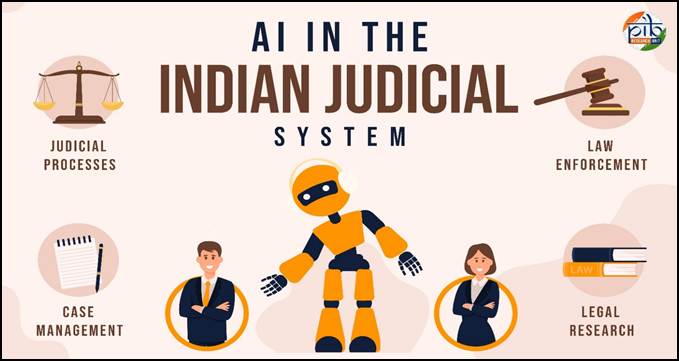
Artificial Intelligence (AI) is no longer a futuristic concept—it is entering courtrooms across the world. In India, the Supreme Court’s eCommittee has begun deploying AI-based tools to improve efficiency, reduce delays, and assist judges in legal research. The Press Information Bureau (PIB) recently highlighted initiatives like LegRAA (Legal Research Analysis Assistant), Digital Courts 2.1, and SUPACE (Supreme Court Portal Assistance in Court Efficiency).
Also Read: Skills Young Lawyers Need for Banking, Finance, and Insolvency Law Careers
Globally, courts in Singapore, the United States, the United Kingdom, and China are also experimenting with AI, from predictive analytics to online dispute resolution. The question now is: how fast can India adopt AI in its judiciary, and what lies ahead for the legal profession worldwide?
India’s AI Journey in Judiciary
Tools Already in Use
- LegRAA: Developed by NIC Pune, helps judges with legal research, document analysis, and decision support.
- Digital Courts 2.1: Provides integrated judgment databases, automated drafting templates, and voice-to-text features (ASR-SHRUTI) with translation (PANINI).
- SUPACE: Still experimental, designed to understand case facts and intelligently search precedents.
- Collaboration with IIT Madras: AI prototypes for defect identification in e-filing, metadata extraction, and integration with case management systems.
Policy Framework
- The AI Committee of the Supreme Court oversees conceptualisation and monitoring.
- Under Phase-III of the eCourts Project (2023–2027), ₹53.57 crore has been allocated for AI and blockchain.
- Pilot deployments are being tested with 200 Advocates-on-Record to ensure responsible adoption.
What Lies Ahead in India
- Faster case disposal: AI can help reduce India’s backlog of over 50 million cases.
- Language translation: Tools like SUVAS (Supreme Court Vidhik Anuvaad Software) will bridge linguistic barriers.
- Predictive analytics: AI may forecast case pendency trends, helping courts allocate resources better.
- Bar adoption: Lawyers will increasingly use AI for drafting, research, and client communication.
Also Read: Gurugram 42,000 foreign liquor bottles Racket Bust Highlights India’s Strict Excise Laws
Global Developments in AI and Law
United States
- Courts use AI for legal research (LexisNexis, Westlaw AI) and predictive analytics in bail and sentencing.
- Concerns remain about algorithmic bias and transparency.
United Kingdom
- AI-driven online dispute resolution (ODR) platforms handle small claims.
- The judiciary is cautious, emphasising human oversight in decision-making.
Singapore
- Known for rapid adoption, Singapore courts use AI for case triaging, scheduling, and translation.
- The government promotes AI as part of its Smart Nation initiative.
China
- China has introduced AI-powered “smart courts” with online filing, automated judgments in minor cases, and facial recognition for litigants.
- Raises global debate on state control vs. judicial independence.
Challenges and Concerns
- Fairness: Can algorithms ensure justice without bias?
- Transparency: AI decisions must be explainable to litigants.
- Data privacy: Sensitive legal data must be protected.
- Human discretion: Judges must retain final authority, with AI as an assistant, not a replacement.
Conclusion
India’s judiciary is cautiously but steadily embracing AI. With tools like LegRAA, SUPACE, and Digital Courts 2.1, the Supreme Court is laying the foundation for a future-ready justice system. Globally, countries are racing ahead, but concerns about fairness, transparency, and accountability remain.
The road ahead for India involves scaling pilot projects, training judges and lawyers, and ensuring ethical frameworks. If done responsibly, AI could transform the judiciary into a faster, more accessible, and more transparent system—delivering justice not just in principle, but in practice.
Also Read: Allahabad High Court Rules GST Notices Cannot Be Deemed Served Only by Portal Upload
GEO Keywords for Faster Searches
- AI adoption Indian judiciary 2025
- Supreme Court SUPACE LegRAA Digital Courts
- eCourts Project Phase-III AI blockchain
- AI in global judiciary US UK Singapore China
- Smart courts AI China India comparison
- SUVAS translation Supreme Court India
- AI legal research Indian bar adoption
- Predictive analytics case pendency India judiciary
- AI fairness transparency judiciary concerns
- Future of AI in law India
Sources:
- PIB – Use of Artificial Intelligence in Legal Field
- Global Voices – AI tools entering India’s courts
- Press Note – Digital Transformation of Justice
- Great Lakes Journal – Can AI Revolutionise India’s Judiciary?
Would you like me to also prepare a shorter 400-word editorial-style version of this article for quick online publication alongside the detailed 1000-word piece?
Also Read: SEBI’s Investor Protection Guidelines Amid India’s ₹148 Trillion Wealth Boom