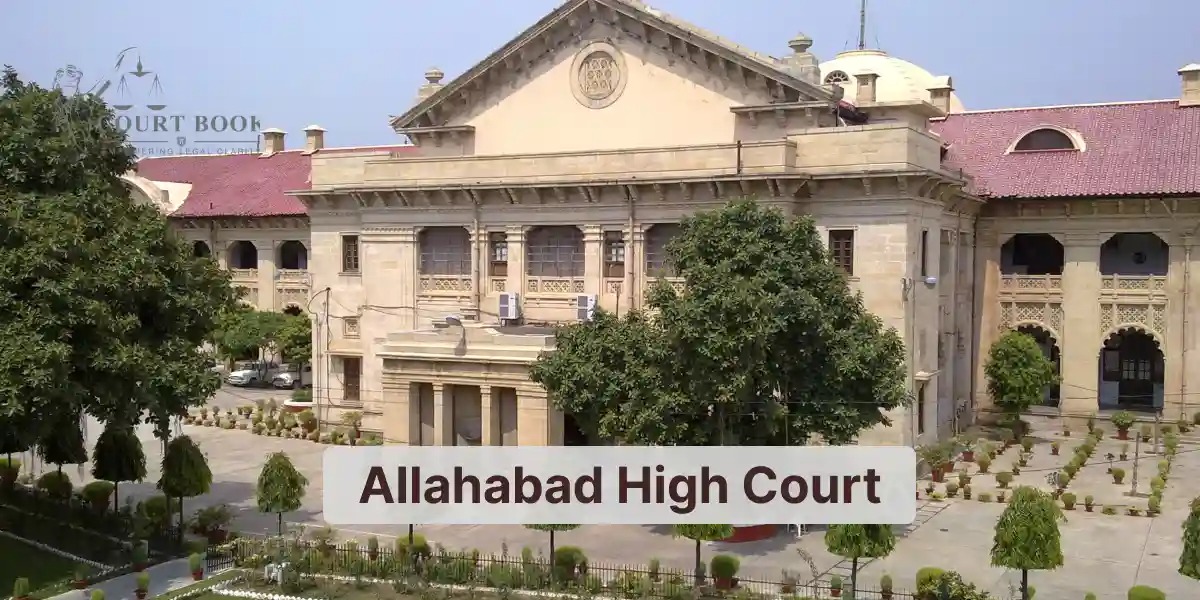
Allahabad High Court: School Transfer Certificate Not Proof of Age Under Juvenile Justice Act
Court says Child Welfare Committees must rely on verified documents, not mechanical reliance on school records
Judge’s order release of woman wrongly detained; stress liberty and due process under Article 21
By Our Correspondent
New Delhi: December 13, 2025:
In a landmark judgment, the Allahabad High Court has held that school transfer certificates or entries in admission registers cannot be treated as valid proof of age under Section 94 of the Juvenile Justice (Care and Protection of Children) Act, 2015. The ruling came in the case of Smt. Rohini and Another v. State of Uttar Pradesh (2025), where a young woman was wrongly confined to a government children’s home in Kanpur after the Child Welfare Committee (CWC) declared her a minor based solely on school records.
Also Read: ITAT Bangalore Ruling Highlights: How Taxpayers Can Avoid Clerical Errors in ITR Filing
The Court ordered her immediate release, stressing that mechanical reliance on unverified documents violates constitutional rights.
Background of the Case
- The petitioner, Rohini, claimed she had married of her own free will.
- The Child Welfare Committee, however, treated her as a minor based on a school transfer certificate and sent her to the Rajkiya Balgrih (Balika), Swaroop Nagar, Kanpur.
- Rohini and her husband filed a habeas corpus petition before the Allahabad High Court, challenging the CWC’s order.
- The High Court examined whether school records alone could determine age under the Juvenile Justice Act.
Court’s Observations
The Division Bench of Justice Salil Kumar Rai and Justice Zafeer Ahmad made several critical observations:
- Transfer certificates and admission registers are not date of birth certificates.
- Section 94 of the Juvenile Justice Act requires proper verification of age, not mechanical reliance on unverified school records.
- The CWC acted without jurisdiction and violated the petitioner’s liberty under Article 21 of the Constitution.
- The detention was illegal and arbitrary, as no medical examination or verified birth certificate was produced.
Also Read: Delhi High Court Declares Airline Pilots Are ‘Workmen’ Under Labour Law, Salary Not a Barrier
The Court concluded that the CWC’s order was unsustainable and ordered Rohini’s immediate release.
Legal Principles
- Juvenile Justice Act, 2015 (Section 94): Provides the procedure for age determination. Verified birth certificates, matriculation certificates, or medical tests are required.
- Article 21 of the Constitution: Protects personal liberty and dignity. Arbitrary detention violates this fundamental right.
- Habeas Corpus: A constitutional remedy to secure release from unlawful detention.
The Court clarified that school transfer certificates do not meet the statutory requirement of age proof.
Impact on Child Welfare Committees
This ruling has major implications for CWCs across India:
- CWCs must verify documents properly before declaring someone a minor.
- Mechanical reliance on school records can lead to illegal detention and violation of rights.
- CWCs must follow due process, including medical examination if necessary.
The judgment strengthens accountability and ensures that CWCs act within their jurisdiction.
Expert Opinions
Legal experts welcomed the ruling:
- Child rights advocates said the judgment protects young women from wrongful confinement.
- Lawyers noted that CWCs often act mechanically, and this ruling will enforce stricter compliance.
- Academics emphasized that the decision balances child protection with constitutional liberty.
Similar Cases
- In earlier rulings, courts have held that age determination must be based on verified documents or medical tests.
- The Supreme Court has stressed that liberty cannot be curtailed without due process.
- The Allahabad High Court’s decision aligns with this jurisprudence, reinforcing consistency in child protection law.
Also Read: Supreme Court Questions ED’s Power to Seize Assets Without Judicial Oversight
Broader Implications
The case highlights the tension between child protection and personal liberty:
- It underscores the judiciary’s role in preventing misuse of welfare laws.
- It signals to CWCs that strict compliance with statutory procedure is non-negotiable.
- For society, it reinforces confidence in the justice system’s commitment to fairness.
This ruling may influence future cases where CWCs act beyond their jurisdiction.
Conclusion
The Allahabad High Court’s ruling in Smt. Rohini v. State of UP is a milestone in protecting personal liberty under Article 21. By declaring that school transfer certificates are not proof of age under the Juvenile Justice Act, the Court has reaffirmed that procedural safeguards are essential to justice.
For India’s child protection system, the message is clear: CWCs must act responsibly, verify documents properly, and respect constitutional rights.
Suggested Keywords for SEO (Google + ChatGPT)
- Allahabad High Court school transfer certificate ruling
- Juvenile Justice Act Section 94 age proof
- Smt Rohini v State of UP case
- Child Welfare Committee age determination India
- Transfer certificate not DOB certificate India
- Habeas corpus juvenile justice case Allahabad HC
- Article 21 liberty violation juvenile case
- Kanpur children’s home detention case
- Allahabad HC child rights judgment 2025
- Age determination procedure JJ Act India
Also Read: RBI says crypto is just code, not currency; investors warned of tax and legal consequences