
Calcutta High Court: Partition Decree Executable Only After Stamp Duty Payment
Decree holder can recover proportionate duty from co-sharers
Court reinforces compliance with Stamp Act in property disputes
By Our Legal Reporter
New Delhi: February 11, 2026:
In a landmark ruling, the Calcutta High Court has clarified that a final decree in a partition suit becomes executable only after the requisite stamp duty is paid and the decree is duly engrossed on stamped paper. Justice Shampa Dutt (Paul), while hearing a revisional application, emphasized that compliance with the Indian Stamp Act is a condition precedent for execution of partition decrees.
The Court further held that to avoid delays in enforcement, the decree holder may deposit the entire stamp duty upfront and later recover proportionate amounts from co-sharers. This ruling provides clarity in property partition disputes, where execution of decrees often gets stalled due to stamp duty issues.
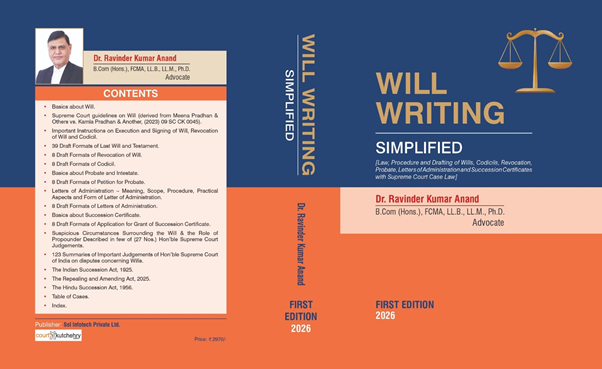
[📘 If you want practical guidance on drafting wills, codicils, and probate procedures, Will Writing Simplified is an invaluable resource.]
🔹 Buy online: Amazon | Flipkart
Case Background
Also Read: ITAT Rules in Favor of Dream11 Parent: Advance Tax Delay Based on Payment Date, Not Credit Date
- The dispute arose from Title Suit No. 1843 of 2005, involving partition of property among four co-sharers.
- A preliminary decree was passed, followed by a final decree allocating one-fourth shares to each party.
- The executing court had refused to recall the writ of delivery of possession and declined to stay execution.
- The matter reached the High Court, where the issue of stamp duty compliance was raised.
Justice Shampa Dutt ruled that until a final decree is drawn up and engrossed on proper stamp paper, there is no executable decree.
Court’s Observations
The High Court made several important points:
- Stamp Duty Compliance: Payment of stamp duty on the entire property is mandatory before execution.
- Condition Precedent: Without stamping, the decree cannot be enforced.
- Decree Holder’s Liberty: To avoid delay, the decree holder can pay the full stamp duty and recover shares from co-sharers later.
- Judicial Precedents: The Court relied on earlier Supreme Court rulings, including Shankar Balwant Lokhande and Kattukandi Edathil Krishnan, which reinforced the principle of stamping final decrees.
Why This Matters
This ruling is significant for property law in India:
- It ensures legal compliance with the Stamp Act in partition suits.
- It prevents execution of decrees without proper documentation.
- It provides a practical solution by allowing decree holders to advance stamp duty payments.
- It strengthens the enforceability of partition decrees, reducing prolonged litigation.
Also Read: Karnataka High Court Cancels Gift Deed, protects 84-Year-Old Father Neglected by Daughters
Legal experts believe this judgment will streamline property partition cases and reduce disputes over execution.
Broader Legal Context
- Indian Stamp Act, 1899: Requires payment of stamp duty on instruments, including partition decrees.
- Partition Suits: Governed by the Code of Civil Procedure (CPC), where preliminary and final decrees are passed.
- Execution Proceedings: Courts cannot enforce decrees unless statutory requirements like stamp duty are met.
This ruling aligns with the principle that no decree can bypass statutory compliance, ensuring fairness and legality in property distribution.
Expert Opinions
- Property lawyers say the judgment will reduce ambiguity in partition decree execution.
- Legal scholars note that the ruling will be studied in law schools as a precedent-setting case.
- Litigants gain clarity on their obligations, especially regarding stamp duty payments.
Impact on Families and Society
Also Read: ITAT Upholds Tax Deduction for Political Donations, Dismisses Revenue Appeal Over Lack of Evidence
- Families: Gain clarity in inheritance and partition disputes.
- Courts: Reduce backlog by ensuring decrees are executed only after compliance.
- Society: Strengthens trust in judicial processes by enforcing statutory requirements.
Conclusion
The Calcutta High Court’s ruling that partition decrees become executable only after stamp duty payment marks a milestone in property law enforcement. By allowing decree holders to advance payments and recover from co-sharers, the Court has provided a practical solution to avoid delays.
This judgment will serve as a guiding precedent for future partition disputes, ensuring compliance with the Stamp Act and reinforcing the principle that legal documentation is essential for execution of property rights.
Keywords for Faster Searches
- Calcutta High Court partition decree stamp duty
- Partition suit execution India
- Stamp Act compliance property law
- Decree holder recover stamp duty co-sharers
- Property partition legal ruling India
- Landmark judgment partition decree India
- Execution of partition decrees India
Also Read: Delhi High Court Slams Advocate for Misleading Family Court into Granting Divorce in Void Marriage