
Can a Deceased Daughter’s Family Claim Her Share in Father’s Property? Supreme Court Clarifies Succession Rights
Hindu Succession Act ensures equal inheritance for daughters
Legal heirs of deceased daughters can step into their shoes
By Legal Reporter
New Delhi: February 11, 2026:
Inheritance disputes are among the most common legal battles in India, often raising questions about the rights of daughters and their families. A recent discussion in courts and financial circles has focused on whether the family of a deceased daughter—her husband and children—can claim her share in her father’s property. The answer lies in the Hindu Succession Act, 1956, and its landmark 2005 amendment, which gave daughters equal rights in ancestral property.
The Supreme Court and various High Courts have repeatedly clarified that daughters enjoy equal coparcenary rights in Hindu Undivided Family (HUF) property, and their heirs can inherit their share even after their death.
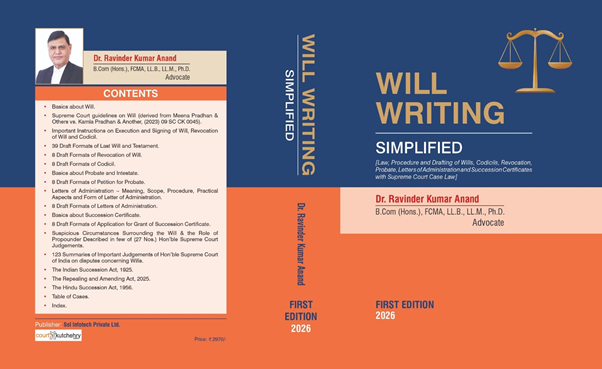
[📘 Legal professionals and students alike will benefit from Will Writing Simplified, which covers procedure and case law in detail.]
🔹 Buy online: Amazon | Flipkart
Legal Framework
- Hindu Succession Act, 1956: Governs inheritance among Hindus when a person dies intestate (without a will).
- 2005 Amendment: Conferred equal coparcenary rights on daughters, making them equal to sons in ancestral property.
- Supreme Court Judgment (Vineeta Sharma v. Rakesh Sharma, 2020): Clarified that daughters acquire coparcenary rights by birth, and the father need not be alive when the amendment came into effect.
Also Read: ITAT Rules in Favor of Dream11 Parent: Advance Tax Delay Based on Payment Date, Not Credit Date
Thus, if a daughter dies before claiming her share, her legal heirs (husband, children) can step into her shoes and demand partition.
Court Rulings and Clarifications
- Supreme Court (2020): Daughters have equal rights in ancestral property, regardless of whether the father was alive in 2005.
- High Court Rulings: If the father died before 1956, succession is governed by old Mitakshara law, which excluded daughters.
- Recent Cases: Courts have held that once property devolves under the Hindu Succession Act, it becomes the individual asset of each heir, not ancestral property.
Consequences for Families
- Deceased Daughter’s Heirs: Her husband and children can claim her rightful share in the father’s property.
- Mother’s Rights: The mother can only gift or transfer her own share, not the entire property.
- Partition Rights: Families can demand partition under the Hindu Succession Act, ensuring equal distribution among heirs.
Why This Matters
This clarification is crucial for families dealing with inheritance disputes:
- It ensures gender equality in succession law.
- It prevents denial of rights to the families of deceased daughters.
- It strengthens the principle that inheritance rights pass on to legal heirs.
Also Read: Karnataka High Court Cancels Gift Deed, protects 84-Year-Old Father Neglected by Daughters
Legal experts believe this ruling will reduce ambiguity in property disputes and empower women’s families to claim their rightful share.
Expert Opinions
- Lawyers: Say the ruling closes loopholes that previously disadvantaged daughters’ families.
- Financial advisors: Recommend families maintain clear documentation of succession to avoid disputes.
- Academics: Note that the judgment will be studied as a milestone in gender justice within property law.
Impact on Society
- Families: Gain clarity on succession rights, reducing conflicts.
- Women’s Rights: Strengthened by equal inheritance provisions.
- Courts: May see fewer disputes as the law becomes clearer.
Conclusion
The Supreme Court’s interpretation of the Hindu Succession Act ensures that a deceased daughter’s family can claim her share in her father’s property. This ruling reinforces gender equality in inheritance and provides clarity for families navigating succession disputes.
Also Read: ITAT Upholds Tax Deduction for Political Donations, Dismisses Revenue Appeal Over Lack of Evidence
By allowing heirs to step into the shoes of deceased daughters, the law ensures that justice and fairness prevail in property distribution.
Keywords for Faster Searches
- Deceased daughter property rights India
- Hindu Succession Act 2005 amendment
- Supreme Court inheritance daughters India
- Coparcenary rights daughters’ property law
- Family claim daughter’s share property India
- Gender equality inheritance law India
- Landmark SC judgment succession rights
Also Read: Supreme Court Revives Forgery Trial in Family Property Dispute