
Delhi High Court Rules AFT Cannot Punish for Contempt of Final Orders
Remedy Lies with High Court Under Contempt of Courts Act
Section 19 of AFT Act Narrowly Interpreted
By Legal Reporter
New Delhi: February 24, 2026:
In a significant ruling, the Delhi High Court has clarified that the Armed Forces Tribunal (AFT) does not have the power to punish for contempt in cases of non-compliance with its final orders. The Court held that once an Original Application (OA) is disposed of the proceedings before the Tribunal come to an end, and any disobedience of its final orders must be addressed through the High Court’s contempt jurisdiction under the Contempt of Courts Act, 1971.
Also Read: Allahabad High Court: 13-Year Delay in Summary Trial Is Gross Abuse of Process
The judgment was delivered by a Division Bench comprising Justice C Hari Shankar and Justice Om Prakash Shukla on February 23, 2026, in the case of Union of India v. Lt Col Mukul Dev.
Case Background
- Dispute: Lt Col Mukul Dev had approached the AFT seeking relief against the Union of India.
- AFT’s Position: The Tribunal had earlier claimed powers to punish for contempt to ensure compliance with its orders.
- Challenge: The Union of India contested this, arguing that the AFT’s powers were limited under the Armed Forces Tribunal Act, 2007.
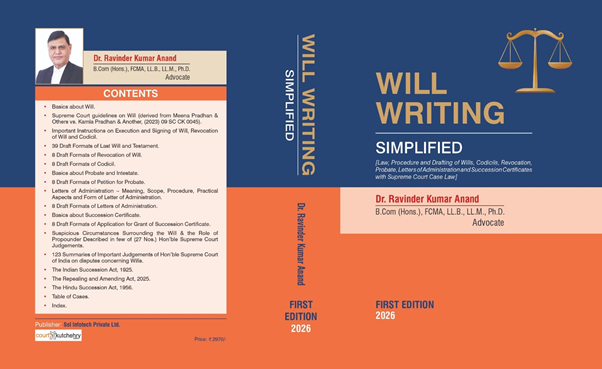
[Recommended Legal Resource]
For those dealing with legal procedures, succession, and drafting of important documents, Will Writing Simplified is an invaluable resource. It offers practical guidance on wills, codicils, probate, and succession certificates with Supreme Court case law. Available on Amazon and Flipkart, the book is a professional tool for lawyers, families, and students of law.
Also Read: Why Jeju Island Visa Rules Confuse Indian Travelers
Court’s Observations
The Delhi High Court made several key points:
- Section 19 of the AFT Act: While it empowers the Tribunal to punish for contempt, the scope is limited to proceedings during the pendency of cases.
- Final Orders: Once an OA is disposed of the Tribunal’s jurisdiction ends. Non-compliance with final orders cannot be punished by the AFT itself.
- Remedy: Aggrieved parties must approach the High Court under Section 10 of the Contempt of Courts Act, 1971.
- Judicial Discipline: The ruling ensures that contempt powers are exercised only by constitutional courts, maintaining judicial hierarchy.
Implications of the Ruling
- For Armed Forces Personnel: They must now approach the High Court if government authorities fail to implement AFT’s final orders.
- For the Government: Reinforces accountability, as non-compliance can still attract contempt proceedings, but only before the High Court.
- For Legal Clarity: Removes ambiguity about the scope of AFT’s powers, ensuring consistency in contempt jurisdiction.
Expert Reactions
Legal experts noted that the ruling balances judicial efficiency with constitutional safeguards. While the AFT remains a specialized forum for military disputes, the High Court retains ultimate authority to enforce compliance through contempt proceedings.
Also Read: CCPA Slaps ₹15 Lakh Penalty on Vajirao & Reddy for Misleading UPSC Ads
Conclusion
The Delhi High Court’s ruling underscores a vital principle: specialized tribunals cannot extend their powers beyond statutory limits. By clarifying that the AFT cannot punish for contempt of its final orders, the Court has reinforced judicial discipline while ensuring that remedies remain available through the High Court.
Suggested Keywords for SEO & Faster Searches
Also Read: The “Boring Money Formula” That Actually Builds Wealth
- Delhi High Court AFT contempt ruling
- Armed Forces Tribunal contempt powers India
- Section 19 Armed Forces Tribunal Act 2007
- Contempt of Courts Act remedy High Court
- Union of India v Lt Col Mukul Dev case
- AFT final orders non-compliance
- Military tribunal powers India
- Will Writing Simplified book
Also Read: Bombay High Court: Single Mother Is a Complete Parent