
Delhi High Court Hears Debate: Can Chartered Accountants and Company Secretaries Appear Before Tribunals?
Advocates Claim Exclusive Right Under Law
Professional Turf War Raises Questions of Representation
By Legal Reporter
New Delhi: February 18, 2026:
A major legal debate has reached the Delhi High Court: should Chartered Accountants (CAs), Company Secretaries (CSs), and Cost Accountants be allowed to argue cases before tribunals? The Bar Council of India (BCI) and the Association of Tax Lawyers have strongly opposed this practice, asserting that only enrolled advocates under the Advocates Act, 1961, have the right to represent clients before courts and tribunals. This case has sparked intense discussion across India’s legal and corporate sectors, highlighting the clash between professional boundaries and practical realities.
[VALUABLE LEGAL RESOURCES]
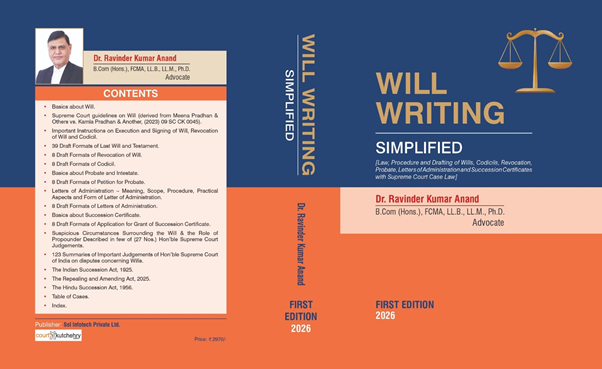
📘 Legal professionals, common people and students alike will benefit from Will Writing Simplified, which covers procedure and case law in detail.
🔹 Buy online: Amazon | Flipkart
The Core Legal Issue
The petitions before the Delhi High Court raise a fundamental question:
- Advocates Act, 1961 – Sections 29, 30, and 33 give advocates exclusive rights to practice law.
- Companies Act, 2013 (Section 432) – Allows parties to authorize CAs, CSs, or cost accountants to represent them before the National Company Law Tribunal (NCLT) and National Company Law Appellate Tribunal (NCLAT).
This apparent conflict between the Advocates Act and the Companies Act has created confusion. While professional bodies for CAs and CSs argue that the Companies Act explicitly permits them to appear, the BCI insists that only advocates can plead cases.
Arguments Presented
Bar Council of India & Tax Lawyers Association
- Advocates alone are trained in law and court procedure.
- Allowing non-advocates to argue cases undermines the legal profession.
- Tribunals are judicial bodies, and representation must remain within the legal fraternity.
Chartered Accountants & Company Secretaries
- Their expertise in taxation, corporate law, and compliance makes them suitable to represent clients in specialized tribunals.
- Section 432 of the Companies Act provides statutory backing for their role.
- Restricting them would harm businesses that rely on their professional knowledge.
Judicial Observations
The Division Bench of Justice Prathiba M. Singh and Justice Madhu Jain have noted the importance of balancing professional rights with statutory provisions. The court is examining whether the Companies Act provision can override the Advocates Act, or whether only advocates should be permitted to appear before tribunals.
Implications for Businesses and Professionals
- For Businesses: Many companies rely on CAs and CSs for representation in corporate and tax matters. Restricting them could increase dependency on advocates, raising costs and procedural delays.
- For Legal Professionals: Advocates argue that their training ensures proper representation and adherence to judicial standards.
- For CAs and CSs: The outcome could redefine their professional boundaries, limiting their role to advisory rather than representational functions.
Historical Context
This debate is not new. Similar disputes have arisen in the past regarding representation before tax tribunals and company law forums. Courts have often leaned towards protecting the exclusive rights of advocates, but statutory provisions like Section 432 of the Companies Act continue to complicate the matter.
Why This Matters
The Delhi High Court’s decision will have far-reaching consequences:
- It could reshape the professional landscape of corporate and tax law practice.
- It may prompt legislative amendments to clarify roles.
- It will directly affect thousands of professionals and businesses across India.
Conclusion
The Delhi High Court’s deliberation on whether Chartered Accountants and Company Secretaries can appear before tribunals is more than a technical legal issue—it is a battle over professional identity and statutory interpretation. While the Advocates Act emphasizes exclusivity for lawyers, the Companies Act opens the door for other professionals. The final ruling will determine whether tribunals remain the exclusive domain of advocates or evolve into multi-professional forums.
Suggested Keywords for SEO & Faster Searches
- Delhi High Court Chartered Accountants tribunals
- Company Secretaries representation NCLT
- Advocates Act vs Companies Act India
- Tax lawyers association Delhi High Court
- CAs and CSs tribunal appearance India
- Legal profession regulation India
- Tribunal representation rights India
- Corporate law practice India
- Will Writing Simplified book
- Professional turf war tribunals India
Also Read: Supreme Court Rules: Loosening Pyjama String Is Attempt to Rape, Quashes Allahabad HC Order