Delhi High Court: GST Bank Account Attachment Lapses After One Year, Orders Release with ₹10 Lakh Minimum Balance
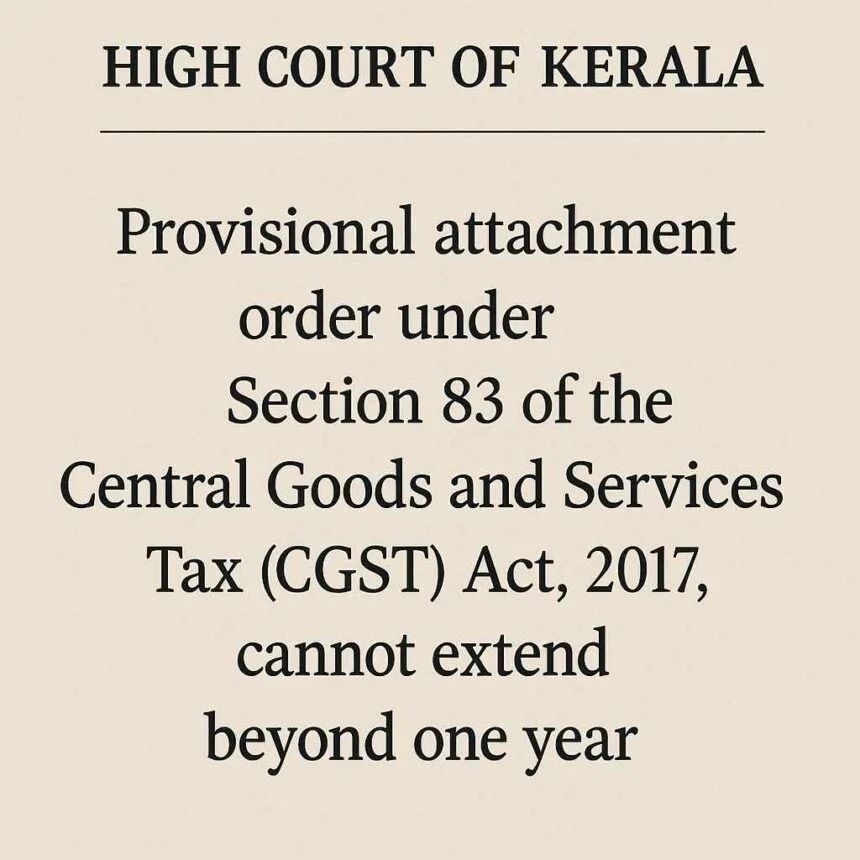
Court clarifies Section 83 attachment cannot continue beyond statutory one-year period under GST Act
Relief to businesses as ruling ensures protection against indefinite freezing of accounts by tax authorities
By Our Legal Reporter
New Delhi: December 01, 2025:
In a landmark judgment, the Delhi High Court has held that provisional attachment orders under Section 83 of the Goods and Services Tax (GST) Act, 2017, automatically lapse after one year. The Court directed the release of a company’s bank account that had been frozen by the Directorate General of GST Intelligence (DGGI), while imposing a condition that the account must maintain a minimum balance of ₹10 lakh.
Also Read: Surat Chartered Accountants Drag CBDT to Gujarat High Court Over Income Tax Portal Failures
This ruling provides significant relief to businesses across India, ensuring that tax authorities cannot indefinitely freeze bank accounts under provisional attachment powers.
Background of the Case
The case involved M/s Aar Gee Impex, whose current account with Kotak Mahindra Bank, Bandra (East), Mumbai was provisionally attached by the DGGI Jaipur Zonal Unit.
- The attachment was made under Section 83 of the GST Act, which empowers tax authorities to provisionally attach property, including bank accounts, to protect revenue interests during pending proceedings.
- The company challenged the attachment, arguing that it had continued beyond the statutory one-year period.
- The Delhi High Court agreed, ruling that such attachments cannot extend beyond one year from the date of the order.
Court’s Observations
The Court made several critical observations:
- Statutory limit of one year: Section 83 clearly states that provisional attachment orders lapse after one year.
- No indefinite freezing: Authorities cannot continue attachment beyond this period without fresh proceedings.
- Balance condition imposed: While directing release of the account, the Court required the company to maintain a minimum balance of ₹10 lakh to safeguard revenue interests.
- Relief to businesses: The ruling ensures that companies are not deprived of liquidity for extended periods due to prolonged attachments.
Why the Ruling Matters
This judgment has wide implications for businesses and tax administration in India:
- Protects business operations: Prevents indefinite freezing of accounts, which can cripple companies.
- Clarifies law: Reinforces the statutory one-year limit under Section 83.
- Balances interests: Safeguards revenue interests while protecting taxpayer rights.
- Sets precedent: Provides guidance for future cases involving provisional attachments.
Also Read: Madras High Court Orders New PAN After Duplicate Allotment Damages Original Holder’s Credit Score
Industry and Legal Impact
Legal experts and industry stakeholders believe the ruling will reshape GST enforcement practices:
- Businesses: Gain confidence that attachments cannot continue indefinitely.
- Tax authorities: Must adhere strictly to statutory timelines.
- Courts: Likely to see fewer disputes over prolonged attachments.
- Economy: Ensures smoother business operations and liquidity.
Expert Reactions
- Tax lawyers hailed the judgment as a victory for taxpayer rights.
- Industry associations welcomed the clarity, saying indefinite attachments had caused severe hardship.
- Policy analysts noted that the ruling balances revenue protection with business continuity.
Lessons for Businesses
The case highlights several lessons:
Also Read: Bombay High Court Upholds SEBI Approval for WeWork India IPO, Dismisses Investor Petitions
- Monitor attachment orders: Businesses must track the one-year statutory limit.
- Challenge prolonged attachments: Companies should approach courts if attachments continue beyond one year.
- Maintain compliance: Ensure GST filings and records are up to date to avoid disputes.
- Seek legal advice: Professional guidance can help navigate complex GST enforcement actions.
Broader Legal Context
Section 83 of the GST Act was designed to protect revenue interests during investigations. However, indefinite attachments often led to hardship for businesses.
The Delhi High Court’s ruling aligns with earlier judgments, including Sutantu Care Pvt. Ltd. vs Superintendent CGST Anti-Evasion and Ms. Krish Overseas vs Commissioner Central Tax, which also held that provisional attachments lapse after one year.
By reinforcing this principle, the Court has ensured consistency in GST jurisprudence.
Conclusion
The Delhi High Court’s ruling that GST provisional attachments lapse after one year is a landmark in tax law. By ordering the release of M/s Aar Gee Impex’s bank account with a ₹10 lakh minimum balance condition, the Court has balanced revenue protection with taxpayer rights.
For businesses, the message is clear: attachments cannot continue indefinitely. For tax authorities, it is a reminder to respect statutory limits. And for India’s economy, it is a step toward greater fairness, transparency, and business confidence.
🔑 Suggested Keywords for SEO & Faster Searches
- Delhi High Court GST Section 83 ruling
- GST provisional attachment lapses after one year
- Bank account release GST Delhi HC
- M/s Aar Gee Impex GST case
- Section 83 GST Act attachment limit
- Delhi HC GST taxpayer rights judgment
- GST bank account freezing India
- Provisional attachment GST Delhi High Court
- GST enforcement taxpayer protection India
- Delhi HC GST ruling November 2025
Also Read: Delhi ITAT Rules Farmhouse is a Residential House, Grants Section 54F Tax Relief