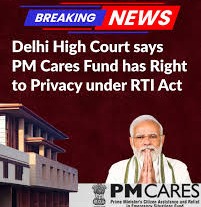
Delhi High Court Rules PM CARES Fund Has Right to Privacy Under RTI Act
Court Says Public Trusts Retain Privacy Rights Even if Government-Run
Section 8(1)(j) RTI Act Bars Disclosure of Third-Party Information
By Our Legal Reporter
New Delhi: January 14, 2026:
In a ruling that has sparked widespread debate, the Delhi High Court on 13 January 2026 held that the Prime Minister’s Citizen Assistance and Relief in Emergency Situations (PM CARES) Fund enjoys the right to privacy under the Right to Information (RTI) Act, even if it is considered a government entity.
Also Read: GST Orders and Natural Justice: Madras High Court Clarifies Same-Day Reply Issue
The Court’s oral observations came while hearing an appeal filed by activist Girish Mittal, who had sought details of the Fund under RTI. The Division Bench of Chief Justice Devendra Kumar Upadhyaya and Justice Tejas Karia emphasized that privacy rights under Section 8(1)(j) of the RTI Act apply to both private and public trusts, and the Fund cannot be denied such protection merely because it is managed by the government.
Background of the Case
- Fund Creation: PM CARES was established in March 2020 during the COVID-19 pandemic to provide financial assistance in emergencies.
- RTI Application: Activist Girish Mittal filed an RTI seeking details of contributions and utilization of funds.
- CIC Order: In 2022, the Central Information Commission (CIC) directed the Income Tax Department to release information.
- Single Judge Order: In 2024, a single judge of the Delhi High Court set aside the CIC order.
- Appeal: Mittal appealed against the single judge’s ruling.
- Division Bench Ruling: On 13 January 2026, the Bench orally remarked that PM CARES retains privacy rights under RTI.
Key Legal Points
- Section 8(1)(j) RTI Act:
- Bars disclosure of personal information unless it serves public interest.
- Applies to third parties, including trusts and institutions.
- Court’s Interpretation:
- PM CARES, even if considered “State” under Article 12, does not lose privacy rights.
- Public functions do not automatically strip entities of privacy protections.
- Distinction from Article 21 Privacy:
- The Court clarified that this is not about the fundamental right to privacy under Article 21.
- It is about statutory privacy under the RTI Act for third parties.
Also Read: Supreme Court Ruling Casts Tax Shadow on Merger Share-Swap Deals
Court’s Observations
- Equal Treatment of Trusts: “There cannot be any difference between the privacy rights of a public or a private trust under the RTI Act.”
- Juristic Personality: PM CARES is a juristic entity and enjoys privacy rights like any other trust.
- No Automatic Disclosure: Merely being government-managed does not mean automatic disclosure of information.
Why This Ruling Matters
- Transparency vs Privacy: The ruling reignites debate on whether public funds should be subject to greater transparency.
- Legal Clarity: Establishes that privacy rights under RTI apply to all entities, regardless of government control.
- Public Interest Concerns: Critics argue that citizens have a right to know how donations to PM CARES are used.
- Judicial Balance: The Court balanced privacy rights with statutory interpretation, leaving larger questions of transparency open.
Broader Implications
- For Citizens: Raises questions about accountability in public fund management.
- For Government Entities: Reinforces privacy protections under RTI.
- For Activists: Sets limits on RTI applications seeking details of government-managed trusts.
- For Judiciary: Highlights the tension between transparency and privacy in governance.
Conclusion
The Delhi High Court’s ruling of January 2026 is a landmark in RTI jurisprudence. By affirming that the PM CARES Fund retains privacy rights under Section 8(1)(j) of the RTI Act, the Court has clarified the scope of statutory privacy protections.
While the decision strengthens privacy rights for public trusts, it also raises critical questions about transparency and accountability in the management of public funds. As debates continue, the ruling underscores the delicate balance between citizens’ right to know and entities’ right to privacy.
Suggested Keywords for SEO & Faster Searches
- Delhi High Court PM CARES Fund ruling
- PM CARES Fund privacy RTI Act
- Section 8(1)(j) RTI Act Delhi HC
- Girish Mittal PM CARES RTI case
- PM CARES Fund government entity privacy rights
- Delhi HC January 2026 PM CARES judgment
- RTI Act privacy rights public trusts
- PM CARES Fund transparency vs privacy debate
- Chief Justice Devendra Kumar Upadhyaya ruling
- Justice Tejas Karia PM CARES case
Also Read: ITAT Mumbai Rules Cash from ₹94 Lakh Property Sale Not Unexplained Income