
ITAT Clarifies: Assessing Officers Cannot Use FMV for Capital Gains While Using Book Value for Business Profits
Delhi Tribunal stresses consistency in tax valuation
Ruling protects taxpayers from artificial inflation of income
By Legal Reporter
New Delhi: March 03, 2026:
In a significant ruling, the Income Tax Appellate Tribunal (ITAT), Delhi Bench, has held that Assessing Officers (AOs) cannot adopt different valuation methods for the same asset when computing capital gains and business income. The judgment, delivered in February 2026, clarifies the scope of Section 45(2) of the Income Tax Act, 1961, which governs taxation when a capital asset is converted into stock‑in‑trade.
The Tribunal emphasized that applying Fair Market Value (FMV) for capital gains while simultaneously using book value for business profits leads to inconsistency and artificially inflates taxable income.
[Suggested Legal Resource]
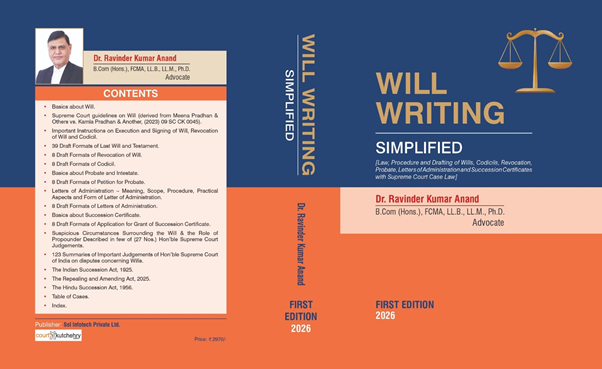
If you want practical guidance on drafting wills, codicils, and probate procedures, Will Writing Simplified is an invaluable resource. BUY HERE NOW: Amazon 🔹 Flipkart
Background of the Case
- The case involved DCIT vs. Cyberwalk Tech Park Pvt. Ltd., concerning assessment year 2012‑13.
- The company had converted land, originally held as a capital asset, into stock‑in‑trade for business purposes.
- The AO computed capital gains using FMV but calculated business profits using book value, resulting in higher tax liability.
- The assessee challenged this dual valuation, arguing that Section 45(2) requires consistency in valuation.
Tribunal’s Observations
- Consistency is Mandatory: The ITAT ruled that once FMV is adopted for capital gains, the same value must be used for computing business profits.
- Section 45(2) Scope: The provision deems conversion of a capital asset into stock‑in‑trade as a transfer, triggering capital gains tax. However, profits from subsequent sale must be computed using the same valuation basis.
- Avoiding Double Taxation: Using FMV for capital gains and book value for business income results in double taxation, which is not permissible.
- Fairness Principle: Tax authorities must ensure fairness and avoid arbitrary methods that inflate taxable income.
Why This Matters
- Taxpayer Protection: The ruling safeguards taxpayers from inconsistent valuation practices that increase tax burdens.
- Clarity in Law: It provides clear guidance on how Section 45(2) should be applied, reducing litigation.
- Impact on Real Estate & Business Conversions: Many businesses convert assets into stock‑in‑trade; this ruling ensures uniform treatment across sectors.
Industry and Expert Reactions
- Tax Professionals: Experts welcomed the ruling, noting it prevents revenue authorities from adopting selective valuation methods.
- Corporate Sector: Companies engaged in real estate and infrastructure projects see this as a relief, as conversions of land into stock are common.
- Legal Circles: The judgment is expected to be cited in future disputes involving asset conversions and valuation inconsistencies.
Wider Context
- Section 45(2) was introduced to tax profits arising from conversion of capital assets into stock‑in‑trade.
- The provision ensures that capital gains are taxed at the time of conversion, while business profits are taxed at the time of sale.
- The ITAT ruling reinforces that both computations must be based on the same valuation method to maintain fairness.
Conclusion
The ITAT Delhi’s ruling that Assessing Officers cannot adopt FMV for capital gains while using book value for business profits is a landmark clarification in Indian tax law. By insisting on consistency, the Tribunal has protected taxpayers from inflated liabilities and ensured fair application of Section 45(2). This judgment will likely shape future assessments and strengthen confidence in the tax system.
Keywords for SEO & Faster Searches
ITAT Delhi ruling FMV vs book value, Section 45(2 Income Tax Act), capital gains asset conversion, Cyberwalk Tech Park case, AO valuation inconsistency, ITAT February 2026 judgment, Indian tax law capital asset conversion, fair market value taxation India, business profits valuation dispute, ITAT protects taxpayers consistency