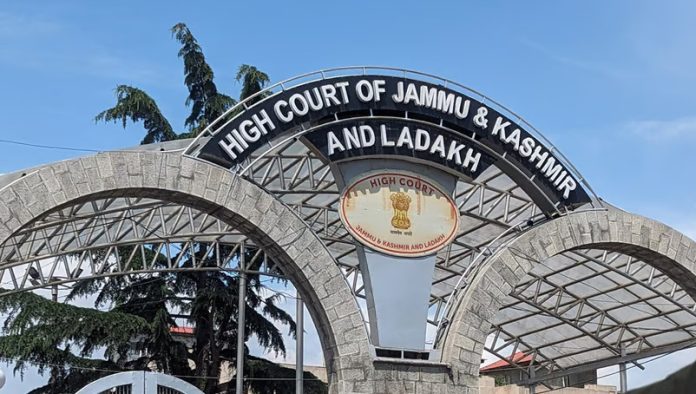
“J&K High Court Quashes Compulsory Retirement: Bad Reputation Allegations Not Enough”
“Court says livelihood cannot be denied on vague claims without service record proof”
“Judges stress that compulsory retirement must be based on cogent material, not mere perception”
By Our Legal Correspondent
New Delhi: January 04, 2026:
In a landmark ruling, the Jammu & Kashmir and Ladakh High Court have quashed the compulsory retirement of a government employee, holding that sweeping allegations of bad reputation unsupported by service records cannot sustain such an order. The Division Bench of Justice Sanjeev Kumar and Justice Sanjay Parihar upheld the writ court’s decision, stressing that compulsory retirement must be based on objective, cogent material rather than vague perceptions.
Also Read: India’s AGR rethink: Supreme Court and government craft a pragmatic path for telecom dues
This judgment is significant as it reinforces the principle that mere involvement in a criminal case does not establish guilt and cannot, by itself, justify depriving a person of livelihood.
Case Background
- The employee was prematurely retired by the government citing “bad reputation.”
- The Screening Committee and competent authority relied mainly on the employee’s involvement in an FIR.
- The writ court quashed the order, and the government appealed.
- The High Court upheld the writ court’s decision, ruling that unsupported allegations cannot justify compulsory retirement.
Court’s Observations
- Bad reputation must be proven Reputation cannot be tarnished by sweeping allegations unsupported by service records.
- Criminal case involvement not enough: Mere registration of an FIR does not establish guilt.
- Supreme Court precedent: The Court relied on State of Punjab v. Surya Kant (2022), which held that compulsory retirement cannot be based solely on criminal involvement.
- Livelihood protection: Premature retirement deprives a person of livelihood and must be exercised cautiously.
Comparison Table: Compulsory Retirement Grounds
|
Basis |
Valid |
Invalid |
|
Service record showing inefficiency or misconduct |
✔ |
✘ |
|
Proven corruption charges |
✔ |
✘ |
|
Vague allegations of bad reputation |
✘ |
✔ |
|
Mere FIR involvement without conviction |
✘ |
✔ |
Implications of the Ruling
- For employees: Provides protection against arbitrary compulsory retirement.
- For government: Reinforces need for objective assessment before invoking retirement powers.
- For judiciary: Strengthens fairness and rule of law in service matters.
- For society: Ensures livelihood cannot be denied based on perception alone.
Wider Context
- Compulsory retirement law: Governments can retire employees in public interest after 25 years of service or age 50, but only with cogent reasons.
- Judicial precedents: Courts have repeatedly held that compulsory retirement cannot be punitive or based on vague allegations.
- Policy implications: The ruling may push governments to strengthen screening processes and rely on service records rather than perceptions.
Expert Views
- Legal experts: Say the ruling protects employees from arbitrary action and strengthens administrative fairness.
- Policy analysts: Note that governments must balance efficiency with fairness in service matters.
- Civil society groups: Welcome the judgment as a safeguard against misuse of compulsory retirement powers.
Conclusion
The J&K High Court’s ruling is a landmark in service jurisprudence. By quashing the compulsory retirement order based on vague allegations of bad reputation, the Court has reinforced the principle that livelihood cannot be denied without cogent material evidence.
For employees, the judgment offers protection against arbitrary action. For governments, it is a reminder to exercise retirement powers responsibly. For the justice system, it strengthens fairness and rule of law in employment matters.
Suggested Keywords (SEO + ChatGPT)
- J&K High Court compulsory retirement ruling
- Bad reputation allegations government employee case
- Premature retirement quashed Jammu Kashmir HC
- State of Punjab v Surya Kant precedent
- Employee rights compulsory retirement India
- Screening committee compulsory retirement case J&K
- Livelihood protection High Court judgment India
- Arbitrary compulsory retirement quashed
Also Read: Delhi High Court Allows NTA Affidavit as NEET-UG 2019 Scorecard: Relief for FMGE Aspirants