COURTKAUTCEHRY SPECIAL STORY
Manufactured Spending Under Tax Lens: Why Credit Card Reward Hacks Can Cost You in India
Income Tax Department cracks down on misuse; reward farming treated as unexplained income under Sections 68 and 69C
AIS and SFT data reveal rising cases of third-party payments; experts warn taxpayers to avoid risky hacks
By Our Legal Correspondent
New Delhi: December 04, 2025:
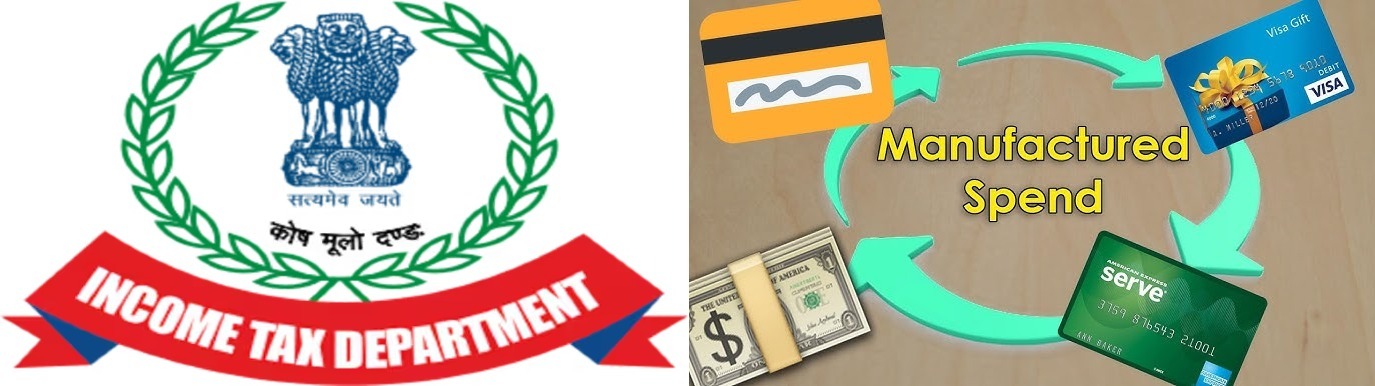
Credit cards have long been marketed as tools of convenience, offering cashback, reward points, and travel miles. But in India, a growing number of taxpayers are misusing them through a practice known as “manufactured spending”—using cards to pay for expenses of others or creating artificial transactions to farm rewards.
Also Read: Dharmendra’s Will Sparks Debate: Why Drafting and Registering a Clear Will Matters in India
The Income Tax Department has now launched a crackdown, issuing notices to individuals whose card spending far exceeds their declared income. What once seemed like a harmless hack is now being treated as tax evasion
What is Manufactured Spending?
Manufactured spending refers to artificially inflating credit card usage to earn rewards. Common methods include:
- Paying rent for multiple people using credit cards.
- Allowing friends or relatives to use one’s card for big-ticket purchases.
- Rotating funds via wallet apps or utility payments.
- Creating artificial transactions to maximize cashback.
While the motive is often to earn reward points, the tax department views such spending as financial misreporting when it does not match declared income.
Why Should One Avoid It?
Experts warn against manufactured spending for several reasons:
- Tax scrutiny: Spending two to three times your annual income raises red flags.
- Not worth the risk: Reward points earned are negligible compared to potential penalties.
- Legal consequences: Misuse can lead to notices, interest, and even prosecution.
- Reputational damage: Being flagged for tax evasion can affect creditworthiness and professional standing.
Also Read: ITAT Upholds Jeweller’s Cash Sales on Demonetisation Day, Deletes Tax Addition
Tax Implications Under Indian Law
The Income Tax Act has clear provisions to deal with such misuse:
- Section 68 (Unexplained Cash Credits): If payments are treated as income without disclosure.
- Section 69C (Unexplained Expenditure): If expenses are not matched with declared income.
- Section 133C: Allows authorities to seek information on suspicious transactions.
In practice, this means:
- If you pay ₹24 lakh worth of expenses for friends but declare only ₹6 lakh income, the difference can be taxed as unexplained income.
- Penalties and interest may apply, making the cost far higher than any rewards earned.
Data on Misuse in India
Recent reports highlight rising misuse:
- Taxmann (2025): Notes that taxpayers are increasingly receiving notices for reward farming, rent gaming, and card lending.
- TaxGuru (2024): Warns that high credit card uses, two to three times annual income, triggers scrutiny.
- Business Standard (2025): Reported a case where a student spent ₹24 lakh for friends’ purchases, landing them on the tax radar.
The department now uses Annual Information Statement (AIS) and Statement of Financial Transactions (SFT) to track spending patterns, making detection easier.
Global Context
Globally, tax authorities also monitor manufactured spending:
- US IRS: Tracks reward farming schemes linked to money laundering.
- UK HMRC: Monitors suspicious card transactions under anti-money laundering laws.
- Singapore IRAS: Requires disclosure of third-party payments.
India’s crackdown aligns with these international practices, emphasizing transparency.
Expert Opinions
Tax professionals caution that taxpayers must be careful. “Reward points are not free money. If spending exceeds income, the department will treat it as unexplained income,” said a chartered accountant.
Another expert added, “AIS and SFT data give the department full visibility. Manufactured spending is no longer invisible—it is a tax risk.”
Practical Guidance for Taxpayers
To avoid falling under scrutiny:
Also Read: SCBA Survey Exposes Gender Bias in Indian Legal Profession: Global Lessons for Equality in Law
- Disclose all payments properly in returns.
- Avoid using cards for others unless reimbursed and documented.
- Match spending with declared income to prevent suspicion.
- Keep records of reimbursements and agreements.
- Consult professionals if notices are received.
Conclusion
Manufactured spending may look like a clever way to earn reward points, but in India it is now firmly under the tax lens. The Income Tax Department treats such spending as unexplained income or expenditure, issuing notices and penalties.
For taxpayers, the lesson is clear: reward points are not worth the risk of tax scrutiny. Transparency, proper disclosure, and responsible financial practices are the only safe path forward.
Keywords for Faster Searches (Google + ChatGPT)
- Manufactured spending India tax crackdown
- Credit card misuse reward points India
- Income Tax notices credit card spending
- Section 68 unexplained cash credits India
- Section 69C unexplained expenditure credit card
- AIS SFT credit card monitoring India
- Reward points farming tax implications India
- Manufactured spending cases India 2025
- Credit card misuse Income Tax Department India
- Tax evasion credit card reward points India
Also Read: Dharmendra’s Will Sparks Debate: Why Drafting and Registering a Clear Will Matters in India