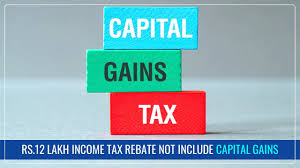
New Tax Regime 2025: ₹60,000 Rebate Limited to Normal Income, Not Short-Term Capital Gains
Finance Ministry clarifies rebate excludes STCG under Section 111A, taxed at flat 15%
Salary earners benefit most, while equity investors must pay full tax on short-term gains
By Our Legal Correspondent
New Delhi: December 01, 2025:
The Union Budget 2025 introduced a ₹60,000 rebate under Section 87A for taxpayers opting for the new tax regime, a move hailed as a major relief for middle-class families. However, the government has now clarified that this rebate applies only to normal income such as salary, pension, or business income. It does not extend to short-term capital gains (STCG) on equity shares and equity mutual funds, which continue to be taxed at a flat rate of 15% under Section 111A of the Income Tax Act.
This clarification is crucial for millions of retail investors who had expected the rebate to reduce their tax liability on stock market gains.
What the Rebate Means
- Section 87A rebate: Taxpayers with taxable income up to ₹7.5 lakh under the new regime can claim a rebate of up to ₹60,000, effectively reducing their tax liability to zero.
- Scope: Applies only to normal income categories.
- Exclusion: STCG under Section 111A and long-term capital gains (LTCG) are excluded.
This means that while salaried individuals and pensioners benefit directly, investors earning short-term gains from equities will not enjoy this rebate.
Why STCG Is Excluded
Also Read: Indian Law Firms Merge for Scale Amid Rising Client Demands and Global Competition
The government explained that capital gains are taxed under separate provisions of the Income Tax Act. STCG on listed equity shares and equity mutual funds is taxed at 15%, irrespective of income level.
Allowing the rebate on STCG would have created double benefits and distorted the tax structure. Hence, the rebate is restricted to normal income only.
Example Scenarios
Case 1: Salaried Individual
- Taxable income: ₹7.2 lakh (salary)
- Under new regime: Eligible for ₹60,000 rebate → No tax payable
Case 2: Investor with STCG
- Taxable income: ₹6 lakh (salary) + ₹2 lakh (STCG)
- Rebate applies only to salary portion.
- STCG of ₹2 lakh taxed at 15% → ₹30,000 tax payable
This shows how investors must separately account for capital gains tax, even if their normal income qualifies for rebate.
Impact on Taxpayers
- Salary earners: Major beneficiaries, as rebate wipes out tax liability up to ₹7.5 lakh.
- Small business owners: Benefit similarly under normal income rules.
- Equity investors: Must pay full tax on STCG, reducing the attractiveness of short-term trading.
- Mixed-income taxpayers: Need to carefully separate normal income and capital gains while filing returns.
Industry Reactions
- Tax experts welcomed the clarity, noting that capital gains taxation must remain distinct to avoid misuse.
- Investor groups expressed disappointment, saying the rebate exclusion discourages retail participation in equities.
- Financial planners advised taxpayers to focus on long-term investments, which enjoy concessional rates and exemptions.
Broader Tax Policy Context
The government has been pushing the new tax regime as the default option, simplifying slabs and reducing exemptions. The ₹60,000 rebate was seen as a sweetener to encourage adoption.
By excluding STCG, the government ensures that capital market taxation remains consistent and avoids overlap with income-based rebates. This aligns with global practices where investment income is taxed separately.
What Taxpayers Should Do
- Separate income streams: Clearly distinguish salary, business income, and capital gains in tax filings.
- Plan investments: Focus on long-term holdings to benefit from lower LTCG rates.
- Use new regime wisely: Salaried individuals with no major exemptions benefit most.
- Consult professionals: Tax advisors can help optimize filings under the new rules.
Also Read: Supreme Court Rules No Review or Appeal Allowed Against Arbitrator Appointment Orders
Conclusion
The clarification that the ₹60,000 rebate applies only to normal income and not to short-term capital gains is a reminder that India’s tax system treats investment income differently. While salaried taxpayers enjoy significant relief, equity investors must continue paying the flat 15% tax on STCG.
This distinction underscores the need for careful tax planning. For the middle class, the rebate is a welcome relief. For investors, it is a call to focus on long-term strategies rather than short-term trading.
🔑 Suggested Keywords for SEO & Faster Searches
- New tax regime rebate ₹60,000 India
- Section 87A rebate 2025 Budget
- Short-term capital gains tax India 15%
- STCG exclusion from rebate India
- Income tax rebate salary pension business income
- Capital gains taxation India 2025
- New regime vs old regime tax benefits
- Section 111A STCG tax rules India
- Tax planning salary vs investment income
- Budget 2025 income tax rebate clarification