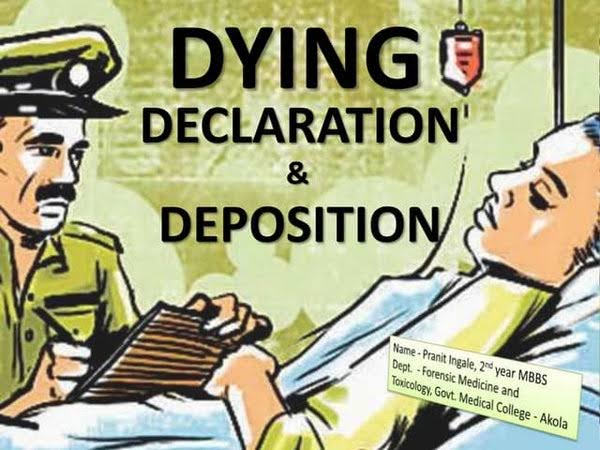
Supreme Court: Dying Declaration Valid Even If Death Is Not Imminent
Court Clarifies Section 32(1) Evidence Act, Strengthens Victim Statements in Criminal Trials
Allahabad High Court Order Quashed; Statements Recorded Under Section 161 CrPC Held Admissible
By Our Legal Reporter
New Delhi: December 10, 2025:
In a landmark judgment, the Supreme Court of India has ruled that imminence of death is not a precondition for the admissibility of a dying declaration under Section 32(1) of the Indian Evidence Act, 1872. The Court clarified that statements made by a deceased person regarding the cause of death or circumstances leading to it remain valid even if recorded days or weeks before the actual death.
This ruling, delivered by a bench of Justices Sanjay Karol and Nongmeikapam Kotiswar Singh, sets aside the Allahabad High Court’s order that had rejected such declarations due to a time gap between recording and death.
Background of the Case
- The case involved a woman allegedly shot by her husband in Bulandshahr, Uttar Pradesh.
- During treatment, she gave two statements under Section 161 of the Criminal Procedure Code (CrPC)—first naming her husband and later implicating her in-laws as instigators.
- She died nearly two months later.
- The trial court and Allahabad High Court refused to treat these statements as dying declarations, citing the time lapse.
- The Supreme Court overturned this, holding that law does not require the declarant to be under the shadow of imminent death.
Supreme Court’s Observations
The Court made several key clarifications:
Also Read: Supreme Court Upholds 100% GST Penalty for Wilful Suppression: AP High Court Order Confirmed
- Imminent Death Not Required: Section 32(1) contains no limitation that the declarant must expect death at the time of making the statement.
- Statements Under Section 161 CrPC Valid: Even if recorded by police officers, such statements become admissible once the declarant dies.
- No Doctor’s Certificate Needed: Lack of medical certification of mental fitness does not automatically invalidate a dying declaration.
- Magistrate’s Presence Not Mandatory: Statements need not be recorded in the presence of a magistrate to be admissible.
- Purpose of Section 319 CrPC: Courts must ensure real offenders are brought to trial; credibility of evidence is tested later, not at the summoning stage.
Legal Significance
This ruling strengthens the evidentiary value of dying declarations in India:
- Victim-Centric Justice: Ensures that victims’ voices are not silenced due to technicalities.
- Clarity in Law: Removes ambiguity about timing and conditions of dying declarations.
- Protection Against Dowry Deaths and Domestic Violence: Many such cases rely heavily on victim statements.
- Guidance for Lower Courts: Prevents premature rejection of crucial evidence.
Comparative Perspective
Globally, dying declarations are recognized under common law traditions:
- UK & US: Admissible if related to cause of death, though some jurisdictions require belief in imminent death.
- India: This ruling clarifies that belief in imminent death is not necessary, making Indian law broader in scope.
Reactions
- Legal Experts: Welcomed the judgment as a progressive step ensuring justice.
- Prosecution: Gains stronger grounds to summon additional accused in dowry and domestic violence cases.
- Defence Lawyers: Expressed concern about potential misuse, stressing need for careful judicial scrutiny at trial.
Also Read: Goa Nightclub Fire Exposes Illegal Operations: Luthra Brothers Face Culpable Homicide Charges
Conclusion
The Supreme Court’s ruling that dying declarations remain valid even without imminent death is a milestone in Indian criminal jurisprudence. By quashing the Allahabad High Court’s restrictive interpretation, the Court has reinforced the principle that justice must prioritize substance over technicalities.
This decision will have far-reaching implications for criminal trials, especially in cases of dowry deaths, domestic violence, and homicide, where victim statements often form the backbone of prosecution.
Suggested Keywords for Faster Searches
- Supreme Court dying declaration ruling India
- Section 32(1) Evidence Act dying declaration
- Imminent death not required dying declaration SC
- Allahabad High Court dying declaration case overturned
- Section 161 CrPC dying declaration admissibility
- Supreme Court dowry death dying declaration
- Justice Sanjay Karol dying declaration ruling
- Indian Evidence Act dying declaration Supreme Court
- Dying declaration validity Supreme Court India 2025
- Criminal trial dying declaration admissibility India
Also Read: ITAT Mumbai Upholds Assessee’s 70:30 Expense Allocation Between Revenue and Capital Work-in-Progress