
Supreme Court Clarifies Limitation Period: Mandatory Injunction Must Be Executed Within 3 Years of Decree If No Performance Date Fixed
Court applies Article 135 of Limitation Act, dismisses plea filed after deadline
Judges stress certainty in execution proceedings to prevent indefinite delays
By Legal Reporter
New Delhi: February 20, 2026:
The Supreme Court of India has ruled that when a decree for a mandatory injunction does not specify a date for performance, the limitation period for execution is three years from the date of the decree. The ruling came in a case where petitioners attempted to enforce a decree more than five years after it was passed. The Court dismissed the plea, reinforcing the principle that execution proceedings must adhere strictly to limitation rules under the Limitation Act, 1963.
Background of the Case
- The dispute originated from a suit filed by Babu Singh (deceased, represented by legal heirs) against the Jalandhar Improvement Trust.
- The First Appellate Court issued a decree for mandatory injunction on January 6, 2005, but did not fix a specific date for performance.
- The petitioners approached the executing court on August 12, 2010, seeking enforcement.
- The application was dismissed as time-barred, a decision upheld by the High Court and later challenged in the Supreme Court.
[Suggested Resource]
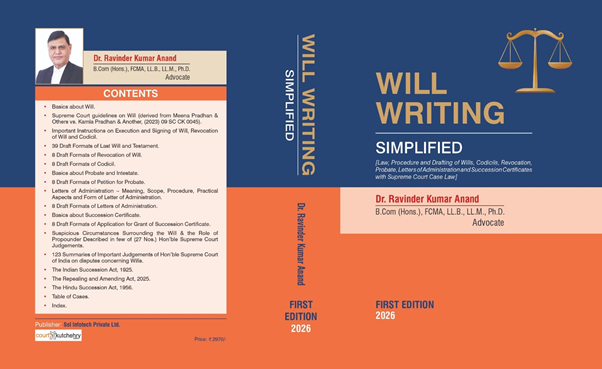
Legal professionals, common people and students alike will benefit from Will Writing Simplified, which covers procedure and case law in detail. Amazon 📘 Buy "Will Writing Simplified" online: 🔹 Flipkart
Supreme Court’s Observations
Also Read: Vijay Mallya Tells Bombay High Court He Cannot Return to India, Cites Passport Revocation and UK Ban
- A bench of Justices Manoj Misra and Manmohan held that under Article 135 of the Limitation Act, 1963, the limitation period for enforcing a mandatory injunction decree is three years from the date of the decree if no performance date is specified.
- The Court emphasized that allowing execution beyond this period would undermine certainty in judicial proceedings.
- It dismissed the Special Leave Petition (SLP), affirming that the execution application was barred by limitation.
Relevant Laws and Provisions
- Limitation Act, 1963 – Article 135: Provides a three-year limitation period for enforcing decrees granting mandatory injunctions.
- Code of Civil Procedure (CPC), 1908: Governs execution of decrees and orders.
- Indian Evidence Act, 1872: Ensures that decrees, once passed, carry evidentiary weight but must be enforced within limitation.
- Constitution of India – Article 14: Reinforces equality before law; limitation rules ensure uniform application across cases.
Why This Matters
- For Litigants: Clarifies that execution of mandatory injunctions must be filed within three years unless a specific performance date is fixed.
- For Courts: Reinforces judicial efficiency by preventing indefinite delays in execution proceedings.
- For Legal Precedent: Strengthens jurisprudence on limitation law, ensuring consistency across civil cases.
Broader Implications
- Legal Strategy: Lawyers must act promptly to enforce decrees, as delay beyond three years will bar execution.
- Judicial Certainty: The ruling prevents misuse of execution proceedings to revive stale claims.
- Property and Civil Disputes: Particularly relevant in injunction cases involving land, construction, or compliance orders.
Expert Views
Legal experts say the ruling underscores the importance of strict adherence to limitation law. Civil lawyers emphasize that execution proceedings are not meant to reopen disputes but to enforce decrees within a fixed timeframe.
Conclusion
The Supreme Court’s ruling that mandatory injunction decrees must be executed within three years of the decree date if no performance date is fixed is a landmark clarification under the Limitation Act, 1963. By dismissing the plea filed after the deadline, the Court has reinforced certainty, efficiency, and fairness in execution proceedings.
Keywords for SEO & Faster Searches
Also Read: Indian Customs Seize Ship with 309 Containers of Walnuts Over Fake Origin Claims
- Supreme Court mandatory injunction limitation 3 years
- Limitation Act Article 135 injunction decree
- Execution of decree time-barred Supreme Court
- Babu Singh vs Jalandhar Improvement Trust case
- Mandatory injunction decree enforcement India
- Supreme Court limitation ruling 2026
- Civil procedure injunction execution India