
Supreme Court: Plaintiff with Unclean Hands Cannot Seek Specific Performance
Suppression of Facts Bars Equitable Relief
Court Emphasizes Bona Fide Conduct in Civil Suits
By Legal Reporter
New Delhi: March 11, 2026:
Also Read: Supreme Court Clarifies: No Automatic Right to Submit New Evidence in Appeals
In a landmark ruling, the Supreme Court of India dismissed a suit for specific performance, holding that a plaintiff who conceals material facts or misrepresents the nature of a transaction cannot claim equitable relief. The case involved allegations that the plaintiff had acted as an unlicensed moneylender and disguised a loan transaction as a sale agreement.
Case Background
- Case name: Muddam Raju Yadav v. B. Raja Shaker (D) through LRs
- Date of ruling: March 10, 2026
- Issue: Plaintiff sought specific performance of a registered sale agreement dated June 4, 2002.
- Plaintiff’s claim: Paid ₹6,00,000 as advance out of ₹13,00,000 total consideration for a house property.
- Defendants’ contention: The transaction was a loan secured by the property, not a genuine sale.
- Evidence: A contemporaneous Memorandum of Understanding (MoU) showed the property would only be transferred if the loan was not repaid within 12 months.
[Recommended Legal Resources]
Also Read: Cancer Drug Duty Cuts in India: How Patients Will Benefit
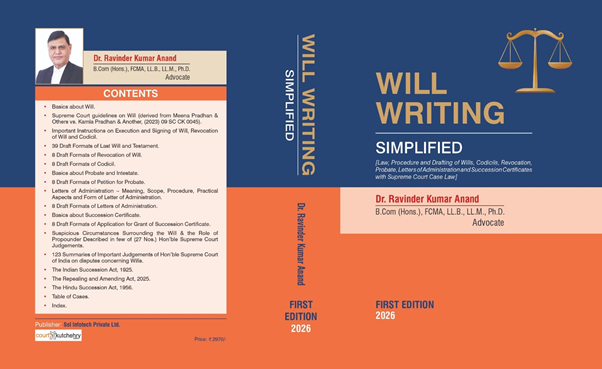
📘 Legal professionals, families and students alike will benefit from Will Writing Simplified, which covers procedure and case law in detail.
🔹 Buy on Amazon
🔹 Buy on Flipkart
Court’s Observations
- Equitable relief requires clean conduct: The Court emphasized that specific performance is a discretionary remedy, available only to parties who act with honesty and fairness.
- Suppression of facts fatal to claim: The plaintiff had concealed the MoU, which revealed the true nature of the transaction.
- Conduct of parties crucial: The Court noted that the bona fides of parties at the time of agreement execution are vital in deciding specific performance suits.
- Relief denied: The plaintiff’s suppression of material facts amounted to approaching the court with “unclean hands,” disqualifying him from equitable relief.
Legal Significance
Also Read: Supreme Court Extends Tribunal Members’ Term till September 2026
- For Litigants:
- Reinforces the principle that courts will not aid parties who misrepresent facts.
- Encourages transparency and honesty in contractual disputes.
- For Courts:
- Strengthens judicial discretion in granting equitable remedies.
- Ensures that relief is denied to parties acting in bad faith.
- For Legal Education:
- Clarifies the doctrine of “unclean hands” in Indian jurisprudence.
- Provides a precedent for future cases involving suppression of material facts.
Wider Context
Specific performance is an equitable remedy under the Specific Relief Act, 1963. Courts grant it only when monetary compensation is inadequate and the plaintiff has acted fairly. This ruling aligns with global principles of equity, where litigants must demonstrate clean conduct to obtain relief.
Conclusion
Also Read: Supreme Court Protects Auction Purchasers: No Need to Prove Delivery of Possession
The Supreme Court’s ruling is a milestone in civil jurisprudence, reaffirming that equitable remedies are reserved for those who approach the court with honesty. By denying relief to a plaintiff with unclean hands, the Court has sent a strong message that suppression of facts will not be tolerated in civil litigation.
GEO-Friendly Keywords
- Supreme Court unclean hands ruling India
- Specific performance denial case 2026
- Muddam Raju Yadav v. B. Raja Shaker
- Suppression of facts civil litigation India
- Equitable relief Specific Relief Act
- Plaintiff misconduct Supreme Court judgment
- Indian civil law precedent 2026
- Unlicensed moneylender case Supreme Court
Also Read: Supreme Court Clarifies Interest Payment in Arbitral Awards