
COURTKUTCHEHRY SPECIAL ON CCI’s INCREASING INTERVENTION TO CHECK UNFAIR TRADE PRACTISES
CCI Fines Intel ₹27 Crore for Unfair Warranty Practices, Signals Stronger Push for Fair Competition in India
Regulator says India-specific warranty policy discriminated against consumers and parallel importers
CCI’s growing interventions highlight stricter enforcement of competition law in technology markets
By Legal Reporter
New Delhi: February 13, 2026:
The Competition Commission of India (CCI) has imposed a penalty of ₹27.38 crore on global chipmaker Intel Corporation for indulging in unfair business practices in India. The fine was levied for Intel’s India-specific warranty policy on boxed microprocessors, which restricted warranty claims to products purchased only from authorized Indian distributors.
Also Read: Supreme Court Quashes SC/ST Act Case Against Vyapam Whistleblower Dr. Anand Rai
The Commission found this policy discriminatory compared to Intel’s warranty practices in other countries such as China and Australia, where warranty claims were honoured regardless of the place of purchase. The ruling underscores CCI’s increasing intervention in India’s technology and digital markets to ensure fair competition and consumer protection.
Case Background
- Intel introduced the India-specific warranty policy in 2016, which remained in effect until 2024.
- The policy restricted warranty claims to purchases made through authorized Indian distributors, excluding parallel imports.
- The case originated from a complaint filed by Matrix Info Systems Pvt. Ltd. under Section 19(1)(a) of the Competition Act.
- After investigation, CCI concluded that Intel had abused its dominant position in the market for boxed microprocessors for desktops.
[Recommended Legal Resource]
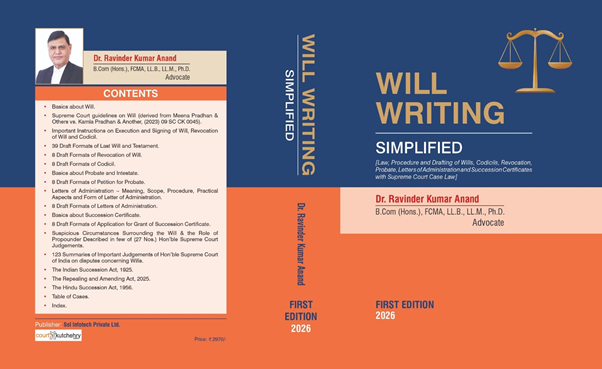
For readers interested in understanding complex legal procedures, drafting of wills, succession laws, and Supreme Court case law, the book Will Writing Simplified [Law, Procedure and Drafting of Wills, Codicils, Revocation, Probate, Letters of Administration and Succession Certificates with Supreme Court Case Law] is highly recommended. It provides practical guidance and case references, making it invaluable for lawyers, law students, and researchers.
Also Read: Supreme Court Rejects Plea for Re-Evaluation of SSC Exam Answers: No Role for Sympathy or Compassion
You can access it here: Amazon | Flipkart
CCI’s Key Observations
Also Read: Supreme Court Halts Talaq-e-Hasan Between Couple, Refers Case to Mediation
- Discriminatory policy: Intel’s India-specific warranty was inconsistent with its global practices.
- Consumer harm: The policy disadvantaged Indian consumers and parallel importers.
- Abuse of dominance: Intel’s market position allowed it to impose restrictive conditions.
- Penalty calculation: The fine was set at 8% of Intel’s average relevant turnover in India.
Implications of the Judgment
- For Consumers: Ensures fair warranty practices and protection against discriminatory policies.
- For Tech Companies: Reinforces that global corporations must align Indian policies with international standards.
- For Regulators: Demonstrates CCI’s proactive stance in monitoring anti-competitive conduct.
- For Market Dynamics: Encourages healthy competition and prevents abuse of dominance in critical sectors like semiconductors.
CCI’s Increasing Intervention in India
This case is part of a broader trend where CCI has stepped up enforcement in recent years:
- Google cases: CCI fined Google for anti-competitive practices in Android mobile ecosystems.
- Amazon and Flipkart investigations: Probes into alleged preferential treatment of sellers.
- Digital markets scrutiny: Growing focus on e-commerce, fintech, and technology platforms.
By penalizing Intel, CCI has signalled that India’s competition law framework is evolving to match global standards, ensuring that multinational corporations cannot exploit Indian consumers through restrictive policies.
Also Read: Punjab & Haryana High Court Declines to Entertain Punjab Kesari Hotel Plea
Broader Legal Significance
The ruling strengthens India’s reputation as a jurisdiction committed to fair trade practices. It also highlights the importance of consumer rights in the digital economy, where warranty and after-sales service are critical.
For legal professionals and businesses, this case illustrates how competition law intersects with consumer protection, setting precedents for future disputes in technology and manufacturing sectors.
Conclusion
The CCI’s fine on Intel marks a landmark moment in India’s competition law enforcement, reinforcing that discriminatory policies will not be tolerated. By holding a global technology giant accountable, the regulator has strengthened consumer rights and signalled its readiness to intervene in complex markets.
This case is not just about Intel—it reflects India’s broader push to ensure fair competition, transparency, and accountability in the digital economy.
Suggested Keywords for Faster Searches
- CCI fine Intel India warranty policy
- Competition Commission Intel penalty 2026
- Intel unfair business practices India
- CCI increasing intervention competition law
- Consumer rights Intel warranty India
- CCI tech companies regulation India
- Intel ₹27 crore fine CCI ruling
- Competition law enforcement India
Also Read: Supreme Court Flags Racket of Fake Motor Accident Claims Using Insured Vehicles