
Chhattisgarh HC: Oral Partition Cannot Deny Daughters’ Coparcenary Rights, Registered Deed or Court Decree Mandatory
Court Says Oral Partition Has No Legal Standing in Property Rights
Daughters’ Rights Under Hindu Succession Act Strengthened by Landmark Ruling
By Our Legal Correspondent
February 09, 2026:
In a significant judgment, the Chhattisgarh High Court has clarified that daughters cannot be denied their coparcenary rights in ancestral property based on oral partition claims. The Court emphasized that under the proviso to Section 6(1) of the Hindu Succession Act, 1956, only a partition effected by a registered instrument or a decree of a competent court prior to December 20, 2004, can be recognized. This ruling reinforces the principle of gender equality in property rights and ensures that daughters enjoy the same legal standing as sons in matters of inheritance.
Background of the Case
- The case was filed by Amrika Bai, daughter of Dhanuk Lodhi and Hemkunwar Bai.
- She challenged the denial of her coparcenary rights on the grounds of an alleged oral partition within the family.
- Lower courts had earlier accepted the oral partition plea, but the High Court set aside those findings, ruling in favour of the daughter.
This decision aligns with the 2005 amendment to the Hindu Succession Act, which granted daughters equal rights as coparceners in joint family property governed by Mitakshara law.
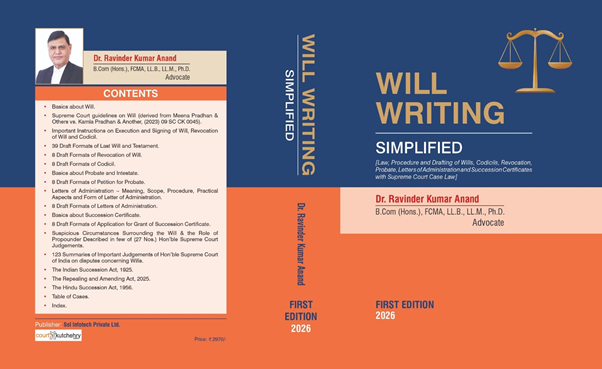
(Laws on Succession are complex. It can overwhelm common people. However, one can get awareness by referencing books on the subject. One such book on Will drafting and understanding, is highly recommended, by CourtKutchehry.com for our esteemed readers.
📘 Legal professionals and students alike will benefit from Will Writing Simplified, which covers procedure and case law in detail. Want to check out? Easy. Just click on the link below and order it now!!!
🔹 Buy on Amazon
🔹 Buy on Flipkart
Why Oral Partition Is Not Enough
- Oral partition claims are often used to deny daughters their rightful share.
- The Court ruled that such claims lack legal validity unless backed by documentary evidence.
- Only registered deeds or court decrees can prove partition under law.
- This ensures transparency and prevents misuse of oral claims to exclude women.
Broader Legal Context
- The Supreme Court of India has repeatedly upheld daughters’ rights in coparcenary property, most notably in Vineeta Sharma v. Rakesh Sharma (2020), where it ruled that daughters have equal rights irrespective of whether the father was alive on the date of the 2005 amendment.
- The Chhattisgarh HC ruling adds another layer of protection by rejecting oral partition as a valid defence.
- This judgment also resonates with other rulings where courts have insisted that daughters must be made necessary parties in succession suits after the 2005 amendment.
Impact of the Judgment
- Strengthens women’s property rights by eliminating loopholes.
- Discourages false oral partition claims often used to sideline daughters.
- Promotes gender equality in inheritance law.
- Sets a precedent for lower courts to follow in similar disputes.
Practical Implications for Families
Also Read: Delhi High Court Orders MEA to Appoint Legal Firm for Celina Jaitly’s Brother Detained in UAE
- Families must ensure that any partition of property is documented through a registered deed or court decree.
- Oral agreements, even if accepted within the family, will not hold legal weight in court.
- Daughters can challenge oral partition claims and assert their rights.
FAQs for Readers
Q1: What is coparcenary property?
It refers to ancestral property jointly owned by members of a Hindu joint family under Mitakshara law.
Q2: Do daughters have equal rights as sons?
Yes. Since the 2005 amendment, daughters are recognized as coparceners with equal rights.
Q3: Can oral partition be accepted in any case?
No. Only registered deeds or court decrees are valid proof of partition.
Conclusion
The Chhattisgarh High Court’s ruling is a milestone in women’s property rights. By rejecting oral partition claims, the Court has ensured that daughters cannot be denied their rightful share in ancestral property. This judgment strengthens the spirit of the Hindu Succession Act and promotes fairness in inheritance disputes.
For legal professionals, students, and families, this case serves as a reminder that documentation is key in property matters. Oral claims may carry social weight, but they hold no legal standing in courts of law.
GEO Keywords for Faster Searches
Also Read: Supreme Court: Husband Must Maintain Ex-Wife Even If She Is Educated or Supported by Parents
- Chhattisgarh High Court oral partition ruling
- Daughters coparcenary rights Hindu Succession Act
- Section 6 proviso Hindu Succession Act 1956
- Oral partition invalid India property law
- Women inheritance rights India 2025 judgment
- Vineeta Sharma daughters property rights case
- Hindu joint family property partition law
- Registered deed court decree property partition
- Gender equality inheritance law India
- Coparcenary rights daughters Supreme Court rulings