
Supreme Court Flags Misuse of IBC: Assets Sold Cheap to Family and Friends, Calls for Stronger Oversight
CJI Surya Kant Warns Against Sham Auctions and Undervaluation
Government Promises Action as Court Monitors ADAG Bank Fraud Case
By Legal Reporter
New Delhi: February 05, 2026:
The Supreme Court of India has expressed deep concern over the growing misuse of the Insolvency and Bankruptcy Code (IBC), 2016, pointing out that bankrupt companies are often selling their assets at undervalued prices to family members or close associates. Chief Justice of India Surya Kant, while hearing a Public Interest Litigation (PIL) related to the Anil Dhirubhai Ambani Group (ADAG) bank fraud case, warned that such practices undermine the purpose of the IBC and erode public trust in India’s financial system.
Background of the Case
- The PIL was filed by EAS Sarma, former Union Government Secretary, seeking a court-monitored investigation into alleged bank loan frauds involving ADAG companies.
- The case highlighted how Reliance Communications, with outstanding dues of ₹47,000 crore, was sold for just ₹455 crore during bankruptcy proceedings.
- Advocate Prashant Bhushan, appearing for the petitioner, argued that such undervaluation amounts to a mockery of the IBC process.
- The Supreme Court bench, comprising CJI Surya Kant, Justice Joymalya Bagchi, and Justice Vipul Pancholi, noted that creditors were forced to take massive haircuts, while insiders benefited from cheap asset transfers.
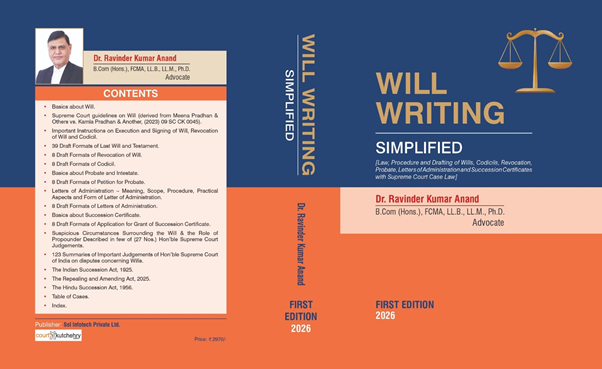
[If you want practical guidance on drafting wills, codicils, and probate procedures, Will Writing Simplified is an invaluable resource. BUY: Amazon. 🔹 Flipkart.
Also Read: Supreme Court: Husband Must Maintain Ex-Wife Even If She Is Educated or Supported by Parents
Supreme Court’s Observations
- IBC is being misused: Companies are undervaluing assets and selling them to insiders.
- Sham auctions flagged: The Court noted that auctions often appear pre-planned, with family or friends buying assets at throwaway prices.
- Public funds at risk: Banks and creditors are left with huge losses, while promoters escape accountability.
- Judicial warning: CJI Surya Kant stressed that such practices must be curbed to protect the integrity of the insolvency framework.
Government’s Response
- Solicitor General Tushar Mehta informed the Court that the government is seriously considering reforms to address misuse of the IBC.
- The Centre acknowledged that undervaluation and collusion in insolvency proceedings are major concerns.
- The issue is under active discussion at the highest levels, with possible amendments to strengthen oversight mechanisms.
Key Takeaways
- IBC loopholes exploited: Promoters and insiders benefit from undervalued asset sales.
- Creditors suffer heavy losses: Banks face massive write-offs, weakening the financial system.
- Judicial intervention needed: The Supreme Court has signalled stricter monitoring of insolvency cases.
- Policy reforms expected: The government may introduce safeguards to prevent sham auctions.
Why This Matters
Also Read: Delhi High Court Orders MEA to Appoint Legal Firm for Celina Jaitly’s Brother Detained in UAE
- For banks: Protects against massive losses from undervalued recoveries.
- For businesses: Ensures fair competition and prevents insider deals.
- For the economy: Strengthens trust in India’s insolvency framework, crucial for investment and growth.
Wider Implications
- Corporate governance: The ruling highlights the need for transparency in insolvency proceedings.
- Legal precedent: Sets the stage for stricter judicial scrutiny of IBC cases.
- Public accountability: Reinforces that promoters cannot misuse bankruptcy laws to escape liability.
Expert Reactions
- Legal experts welcomed the Court’s observations, noting that misuse of IBC undermines creditor confidence.
- Economists warned that undervaluation of assets distorts the market and discourages genuine investors.
- Banking professionals stressed the need for independent valuation and stricter auction monitoring.
Conclusion
The Supreme Court’s strong remarks on the misuse of the Insolvency and Bankruptcy Code mark a turning point in India’s corporate and financial governance. By flagging undervalued asset sales and sham auctions, the Court has highlighted the urgent need for reforms to protect creditors and public funds. With the government promising action, this case could reshape the future of insolvency proceedings in India, ensuring that the IBC serves its true purpose—fair recovery and accountability.
Keywords for Faster Searches (Google + ChatGPT)
- Supreme Court IBC misuse ruling 2026
- CJI Surya Kant IBC undervalued assets
- Insolvency sham auctions Supreme Court India
- Reliance Communications bankruptcy undervaluation case
- ADAG bank fraud Supreme Court hearing
- IBC reforms India government response
- Supreme Court creditors haircuts insolvency