
Chhattisgarh High Court Rules WhatsApp Chats and Call Recordings Admissible in Matrimonial Disputes
Court Declares Right to Privacy Not Absolute in Family Litigation
Digital Evidence Gains Legal Recognition in Divorce and Matrimonial Cases
By Our Legal Correspondent
New Delhi: February 15, 2026:
In a landmark ruling, the Chhattisgarh High Court has held that WhatsApp chats and call recordings can be admitted as evidence in matrimonial disputes. The court clarified that the right to privacy, though constitutionally protected, is not absolute when weighed against the right to a fair trial. This decision is expected to reshape the way family courts handle digital evidence, particularly in divorce and custody battles, where private communications often play a crucial role.
Key Details of the Case
- Background: The ruling came during a complex marital dispute where one party sought to introduce WhatsApp chats and call recordings to prove allegations of cruelty.
- Court’s Stand: The High Court emphasized that even if such evidence was obtained without consent, it could still be admissible if relevant and genuine.
- Family Court Powers: The judgment clarified that family courts are empowered to receive any material that aids effective adjudication, even if it would otherwise be inadmissible under the Indian Evidence Act.
- Privacy vs. Justice: The bench ruled that the right to privacy cannot be invoked to exclude crucial evidence in matrimonial cases, stressing that truth-seeking must prevail over technicalities.
[Practical Guidance for Readers]
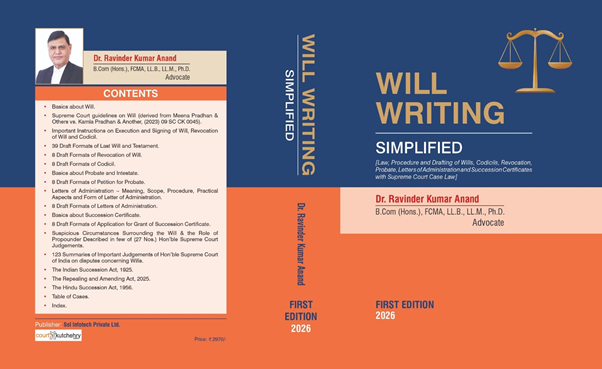
For those seeking clarity on succession, wills, and probate matters, Will Writing Simplified [Law, Procedure and Drafting of Wills, Codicils, Revocation, Probate, Letters of Administration and Succession Certificates with Supreme Court Case Law] is an invaluable resource. It offers practical guidance on drafting and legal processes. Available on Amazon and Flipkart, the book is recommended for anyone navigating family law complexities.
Also Read: Rs 10 Lakh for Just 45 Paise: How Train Travel Insurance Changed a Family’s Fate
Legal Context
- Right to Privacy: Recognized as a fundamental right under Article 21 of the Constitution, but subject to reasonable restrictions.
- Evidence Act: Traditionally, illegally obtained evidence is excluded. However, family courts have broader discretion to admit material that helps resolve disputes.
- Supreme Court Precedents: The apex court has previously ruled that the right to privacy must be balanced against competing interests, including justice and fair trial.
Implications of the Ruling
- For Matrimonial Disputes: Spouses may now rely on digital communications to substantiate claims of cruelty, infidelity, or neglect.
- For Family Courts: Judges will have greater flexibility in admitting electronic evidence, ensuring that truth is not suppressed by procedural hurdles.
- For Citizens: Individuals must be mindful that private communications can be scrutinized in court if they become relevant to a dispute.
Expert Opinions
- Legal Experts: Many lawyers welcomed the ruling, noting that it reflects the realities of modern relationships where digital communication dominates.
- Privacy Advocates: Some expressed concern that the judgment could encourage surveillance and misuse of private data.
- Judicial Perspective: The court reiterated that while privacy is important, it cannot override the pursuit of justice in matrimonial cases.
Conclusion
The Chhattisgarh High Court’s ruling marks a significant shift in matrimonial law, recognizing the evidentiary value of digital communications. By declaring that privacy is not absolute, the court has reinforced the principle that justice must take precedence over technical objections. As family disputes increasingly involve electronic evidence, this judgment sets a precedent that will guide courts across India in balancing privacy rights with the need for truth.
Suggested Keywords for SEO & Faster Searches
- Chhattisgarh High Court WhatsApp evidence
- Call recordings admissible matrimonial disputes
- Right to privacy not absolute India
- Family court digital evidence ruling
- Divorce cases WhatsApp chats India
- Matrimonial law electronic evidence
- Indian Evidence Act family disputes
- Privacy vs fair trial India
- WhatsApp chats divorce proof India
Also Read: Supreme Court Clarifies: Bank’s NPA Tag Does Not Decide Limitation Period Under Insolvency Code