
COURTKUTCHEHRY SPECIAL ON KEY DIFF BETWEEN INDIA & AUSTRALIAN DVIORCE LAWS
Delhi Court Rejects Australian ‘Property Settlement’ Order in Shikhar Dhawan Case
Ex-Wife Directed to Return ₹5.72 Crore
Indian Law vs. Australian Law: Key Differences Explained
By Legal Reporter
New Delhi: February 25, 2026:
Indian cricketer Shikhar Dhawan has secured a major legal victory in his long-running matrimonial dispute. A Delhi Family Court has ordered his ex-wife, Aesha Mukerji, to return ₹5.72 crore that Dhawan was compelled to pay under an Australian court’s “property settlement” order. The ruling highlights the complexities of cross-border family disputes and underscores the differences between Indian and Australian matrimonial laws.
Also Read: Allahabad High Court: ‘No Conversion, No Crime’ – Police Protection Granted to 12 Interfaith Couples
Judge Devender Kumar Garg of Patiala House Courts held that the Australian concept of “property settlement” is alien to Indian law and cannot be enforced in India. The court also found that Dhawan had signed documents under coercion and trickery, rendering them null and void.
[Legal Note]
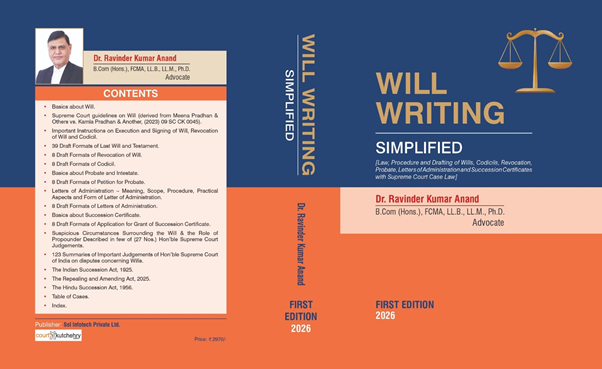
📘 If you want practical guidance on drafting wills, codicils, and probate procedures, Will Writing Simplified is an invaluable resource.
🔹 Buy Will Writing Simplified online: Amazon | Flipkart
Background of the Dispute
Also Read: The Great Biryani Audit: How Hyderabad’s Restaurant Raids Exposed a ₹70,000 Crore Tax Scam
- Dhawan married Aesha Mukerji, an Australian citizen, in 2012.
- The couple later separated, leading to legal battles in both India and Australia.
- An Australian family court ordered Dhawan to pay large sums under the principle of “property settlement,” which divides marital assets between spouses after separation.
- Dhawan challenged the enforceability of this order in India, arguing that Indian matrimonial law does not recognize such settlements.
Supreme Court and Delhi Family Court Proceedings
- The Delhi Family Court examined whether the Australian order could be enforced in India.
- It ruled that Indian law, particularly the Hindu Marriage Act, 1955, does not recognize “property settlement” as a matrimonial relief.
- The court emphasized that Indian matrimonial law focuses on maintenance, alimony, and custody, not division of property acquired during marriage.
- Consequently, Dhawan’s ex-wife was directed to return the funds, along with interest.
Key Differences Between Australian and Indian Matrimonial Laws
| Aspect | Australian Law | Indian Law |
|---|---|---|
| Property Settlement | Recognized under the Family Law Act, 1975. Courts can divide marital property, including assets acquired during marriage, regardless of ownership. | Not recognized. Property division is not part of matrimonial relief. Ownership remains with the titleholder unless voluntarily transferred. |
| Maintenance/Alimony | Spousal maintenance may be ordered, but property settlement is the primary mechanism for financial adjustment. | Maintenance and alimony are recognized under the Hindu Marriage Act and CrPC Section 125. |
| Custody | Decisions based on “best interests of the child,” with shared parenting often encouraged. | Custody determined under Guardians and Wards Act, 1890 and personal laws, focusing on welfare of the child. |
| Enforceability of Foreign Orders | Australian orders are binding within Australia. Enforcement abroad depends on recognition by foreign courts. | Indian courts may refuse enforcement if the foreign order is contrary to Indian law or public policy. |
| Judicial Philosophy | Emphasis on equitable distribution of assets to ensure fairness post-divorce. | Emphasis on protecting dependent spouse and children through maintenance, not redistribution of property. |
Also Read: Orissa High Court Quashes Order Allowing 50 Police Officers to File Property Declarations Late
Why the Delhi Court Rejected the Australian Order
- Contrary to Indian Law: The concept of property settlement does not exist in Indian matrimonial statutes.
- Public Policy Concerns: Enforcing such an order would undermine Indian legal principles.
- Coercion and Trickery: The court found Dhawan had signed documents under pressure, making them void.
Implications of the Ruling
- For Dhawan: A major financial relief, as he recovers funds previously transferred.
- For Cross-Border Marriages: The case highlights the challenges of reconciling different legal systems in matrimonial disputes.
- For Indian Law: Reinforces the principle that foreign judgments cannot override Indian statutory provisions.
Expert Opinions
Legal experts note that the ruling underscores the importance of jurisdiction in matrimonial cases. While Australian courts may apply equitable distribution, Indian courts prioritize statutory provisions and public policy. This case may serve as a precedent for future disputes involving cross-border marriages.
Timeline of Events
- 2012: Dhawan marries Aesha Mukerji.
- 2020–2024: Marital disputes escalate; proceedings initiated in Australia.
- 2025: Australian court orders Dhawan to pay under “property settlement.”
- Feb 2026: Delhi Family Court rules against enforceability of Australian order, directing return of ₹5.72 crore.
Also Read: BCI Issues Detailed Guidelines for AIBE XXI: Rules Every Candidate Must Know
Conclusion
The Shikhar Dhawan case illustrates the complexities of international family law disputes. While Australian law emphasizes equitable distribution of property, Indian law focuses on maintenance and alimony. The Delhi Family Court’s ruling reaffirms that foreign judgments cannot be enforced if they contradict Indian legal principles.
This case is a reminder for couples in cross-border marriages to understand the legal frameworks of both countries, as differences in matrimonial law can lead to significant consequences.
GEO Keywords for Faster Searches
- Shikhar Dhawan family dispute Delhi court
- Australian property settlement vs Indian law
- Shikhar Dhawan ex-wife Aesha Mukerji case
- Delhi Family Court ruling Dhawan
- Cross-border matrimonial disputes India Australia
- Property settlement law differences India Australia
- Hindu Marriage Act vs Family Law Act Australia
Also Read: India–France Tax Treaty Amended: Lower Dividend Tax to Boost Trade and Investment