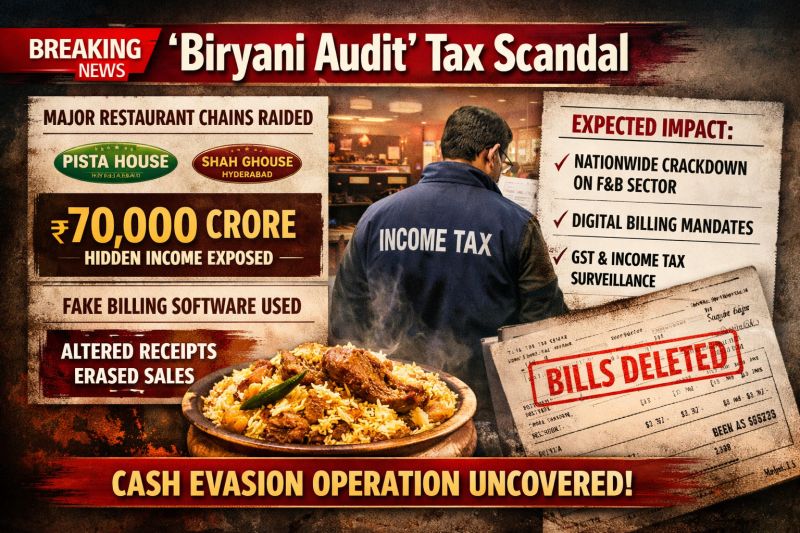
COURT KUTCHEHRY SPECIAL ON Hyderabad biryani restaurant tax evasion probe, dubbed “The Great Biryani Audit
The Great Biryani Audit: How Hyderabad’s Restaurant Raids Exposed a ₹70,000 Crore Tax Scam
AI Analysis of 60TB Data Uncovered Ghost Billing
From UPI IDs to Locker Cash – Anatomy of the Probe
By Our Legal Correspondent
New Delhi: February 24, 2026:
What began as a routine tax inspection of popular biryani restaurants in Hyderabad has snowballed into one of the largest tax evasion scandals in India’s food industry. Dubbed the “Great Biryani Audit”, the investigation revealed a ₹70,000 crore billing scam involving suppressed sales, ghost bills, multiple UPI IDs, and locker cash.
Also Read: Centre Bans MoodXVIP, Jugnu and 3 Other OTT Platforms for Streaming Obscene Content
The probe, led by the Income Tax Department’s Hyderabad investigation unit, has shaken the restaurant sector nationwide, exposing how digital loopholes and underreporting were used to evade taxes on a massive scale.
How It All Began
- In November 2025, tax officials conducted raids on three major biryani chains in Hyderabad: Pista House, Shah Ghouse Café, and Mehfil.
- The raids covered nearly 30 locations, including restaurants, corporate offices, and residences of senior management.
- Initial suspicion arose from discrepancies in billing records and unusually high cash deposits compared to reported sales.
The Digital Trail
The turning point came when investigators seized digital records:
- 60 terabytes of billing data from a pan-India restaurant billing software.
- 1.77 lakh restaurant IDs linked to the system.
- Multiple UPI accounts used to divert payments outside official records.
Using artificial intelligence (AI), officials analyzed the data and discovered that restaurants had suppressed sales worth ₹70,000 crore since 2019–20.
Also Read: Supreme Court: Restructuring Arrangements Cannot Stall Insolvency Proceedings
Ghost Bills and Locker Cash
The probe revealed several tactics:
- Ghost Billing: Fake bills generated to match reported sales while actual transactions were hidden.
- UPI Diversions: Payments routed through personal UPI IDs instead of official accounts.
- Locker Cash: Large amounts of unaccounted cash stored in lockers linked to restaurant owners.
- Split Transactions: Bills split into smaller amounts to avoid detection.
Anatomy of the Scam
- Customer Pays via UPI → Payment routed to unofficial IDs.
- Ghost Bill Generated → Fake entry created in billing software.
- Cash Deposited in Lockers → Unreported income stored physically.
- Suppressed Sales → Official records showed lower turnover, reducing tax liability.
Scale of the Scam
- ₹70,000 crore suppressed turnover across India’s food industry.
- Thousands of restaurants implicated through billing software analysis.
- Multi-crore evasion concentrated in Hyderabad chains but spreading nationwide.
Why This Scam Was Busted Now
- AI Integration: The use of advanced analytics allowed investigators to process massive datasets.
- Digital Payments Boom: UPI transactions left trails that could be traced back.
- Cross-Verification: Comparing GST filings with actual billing data exposed discrepancies.
Also Read: Supreme Court to Examine Housing Society’s Refusal of EV Charger Installation
Impact on the Restaurant Industry
- Trust Deficit: Customers question transparency of billing practices.
- Regulatory Scrutiny: Restaurants across India now face tighter audits.
- Policy Push: Calls for stricter monitoring of digital billing software.
Expert Reactions
Tax experts hailed the probe as a watershed moment in India’s fight against tax evasion. They noted that while digital payments were meant to increase transparency, loopholes in billing systems allowed restaurants to exploit the system.
[Recommended Legal Resource]
For those navigating complex legal documentation, especially in cases involving succession and compliance, Will Writing Simplified is an invaluable resource. It provides practical guidance on wills, codicils, probate, and succession certificates with Supreme Court case law. Available on Amazon and Flipkart, it is a professional tool for families, lawyers, professionals.
Also Read: Supreme Court Rules Voluntary Confession Can Be Substantive Evidence Under Customs Act
Conclusion
The Great Biryani Audit is more than just a Hyderabad story—it is a wake-up call for India’s food and beverage industry. By exposing how restaurants manipulated billing systems to evade taxes, the probe has highlighted the need for stronger digital oversight, stricter compliance, and transparent practices.
With ₹70,000 crore in suppressed sales uncovered, this case stands as one of the biggest tax scandals in India’s history, proving that even a plate of biryani can reveal the anatomy of a nationwide scam.
Suggested Keywords for SEO & Faster Searches
- Hyderabad biryani tax evasion scam
- Great Biryani Audit India
- Restaurant ghost billing UPI fraud
- ₹70,000 crore suppressed sales India
- Income Tax raids Hyderabad restaurants
- AI analysis restaurant billing scam
- Pista House Shah Ghouse Mehfil tax probe
- Will Writing Simplified book
Also Read: ITAT Quashes Income Tax Revision Against Mukul Rohatgi: PCIT Cannot Rely on AI Rental Yield Reports