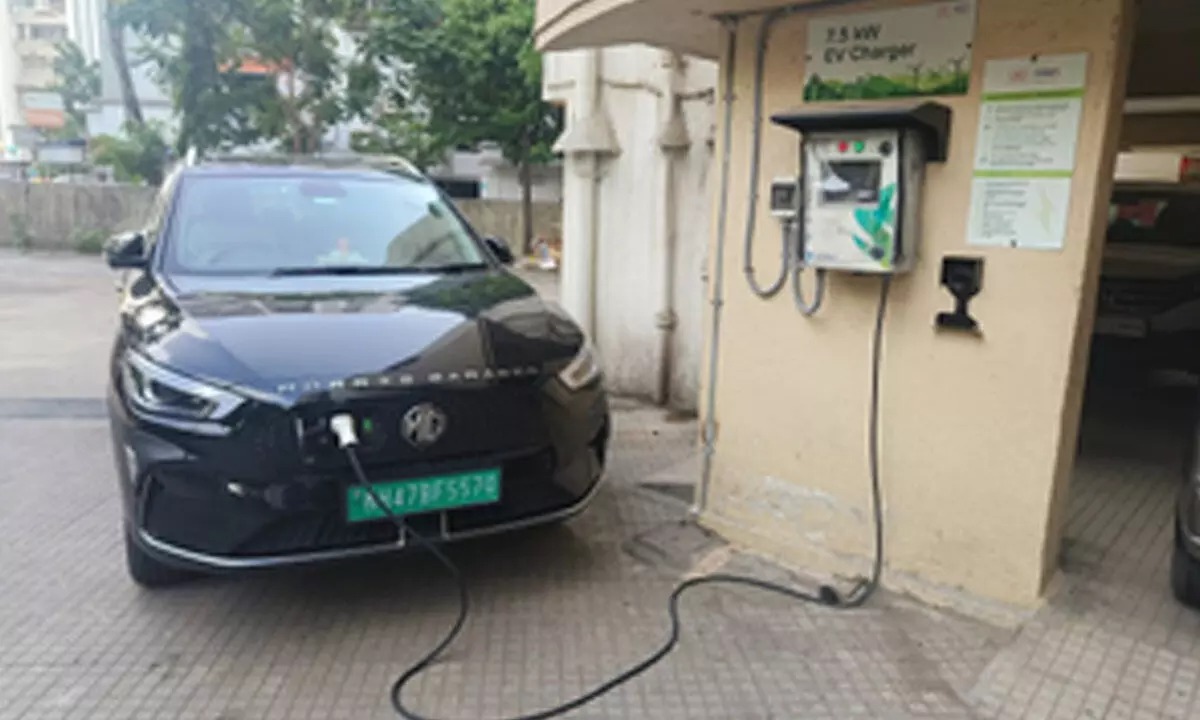
Supreme Court to Examine Housing Society’s Refusal of EV Charger Installation
PIL Seeks Enforcement of Power Ministry Guidelines
Court Issues Notice to Centre, UP Government, and Noida Society
By Legal Reporter
New Delhi: February 25, 2026:
The Supreme Court of India has agreed to hear a Public Interest Litigation (PIL) filed by a Greater Noida resident after his housing society refused permission to install an electric vehicle (EV) charger in his designated parking space. The petitioner, Rachit Katyal of Nirala Estate Phase-3, argued that the refusal violates the Ministry of Power’s Guidelines for EV Charging Infrastructure (2024), which mandate that housing societies cannot arbitrarily deny residents the right to install chargers at their own expense.
Also Read: Allahabad High Court: ‘No Conversion, No Crime’ – Police Protection Granted to 12 Interfaith Couples
A bench led by Chief Justice of India Surya Kant and Justice Joymalya Bagchi issued notices to the Union Government, the State of Uttar Pradesh, and the housing society, seeking their response. The matter is scheduled for hearing on April 13, 2026.
Background of the Case
- The petitioner purchased an EV and sought to install a charger in his allotted parking bay.
- The housing society management denied permission, citing internal policies and infrastructure concerns.
- Katyal approached the Supreme Court, arguing that the denial violates central government guidelines and obstructs India’s push towards clean mobility.
- The PIL seeks effective implementation of the Ministry of Power’s guidelines across housing societies nationwide.
Power Ministry Guidelines on EV Charging (2024)
The Guidelines for Installation and Operation of EV Charging Infrastructure (September 17, 2024) issued by the Ministry of Power are central to this case. Key provisions include:
- Right to Install Chargers: Residents in housing societies have the right to install EV chargers in their designated parking spaces at their own cost.
- No Arbitrary Denial: Housing societies and Resident Welfare Associations (RWAs) cannot deny permission without valid technical reasons.
- Standardization: Chargers must comply with safety and technical standards prescribed by the Bureau of Indian Standards (BIS).
- Distribution Companies (DISCOMs): Required to facilitate connections and upgrades to support EV charging demand.
- Public and Private Infrastructure: Guidelines encourage both public charging stations and private installations to accelerate EV adoption.
- Green Mobility Push: The guidelines align with India’s target of achieving 30% EV penetration by 2030.
Also Read: The Great Biryani Audit: How Hyderabad’s Restaurant Raids Exposed a ₹70,000 Crore Tax Scam
Supreme Court’s Observations
- The Court noted that housing societies cannot frustrate national policy objectives by arbitrarily denying permissions.
- It emphasized the need for effective enforcement of the guidelines to ensure smooth adoption of EVs.
- The bench sought responses from the Union Government and the State of Uttar Pradesh on how they plan to implement the guidelines.
[Recommended Legal Note]
📘 If you want practical guidance on drafting wills, codicils, and probate procedures, Will Writing Simplified is an invaluable resource.
🔹 Buy Will Writing Simplified online: Amazon | Flipkart
Key Legal Issues
- Residents’ Rights vs. Society Rules: Whether housing societies can override central government guidelines.
- Enforceability of Guidelines: Whether the Ministry of Power’s guidelines have binding legal force.
- Environmental Policy: The case touches upon India’s constitutional commitment to sustainable development under Article 21 (Right to Life).
Implications of the Case
Also Read: Orissa High Court Quashes Order Allowing 50 Police Officers to File Property Declarations Late
- For EV Owners: A favourable ruling would empower residents across India to install chargers without facing arbitrary denials.
- For Housing Societies: They may need to revise internal policies to align with national guidelines.
- For India’s EV Policy: The case could accelerate infrastructure rollout, supporting India’s climate goals.
Expert Opinions
Policy experts argue that housing societies must adapt to the EV revolution. Denying chargers discourages adoption and undermines India’s clean energy transition. Legal experts add that guidelines, though administrative, carry significant weight when linked to constitutional rights and national policy.
Timeline of Events
- Sept 2024: Ministry of Power issues EV charging guidelines.
- Feb 2026: Resident files PIL after denial by Greater Noida housing society.
- Feb 2026: Supreme Court issues notice to Centre, UP Government, and housing society.
- April 13, 2026: Case listed for final hearing.
Also Read: BCI Issues Detailed Guidelines for AIBE XXI: Rules Every Candidate Must Know
Conclusion
The Supreme Court’s intervention in the EV charger dispute highlights the growing importance of infrastructure in India’s clean mobility transition. By examining the enforceability of the Power Ministry’s guidelines, the Court will determine whether residents can freely install chargers in housing societies. The outcome will have far-reaching implications for EV adoption, urban housing policies, and India’s climate commitments.
GEO Keywords for Faster Searches
- Supreme Court EV charger housing society case
- Power Ministry EV charging guidelines 2024
- EV charger installation rights India
- Housing society EV charger denial Supreme Court
- EV infrastructure policy India Supreme Court
- Electric vehicle charging guidelines India
- Greater Noida EV charger PIL
Also Read: India–France Tax Treaty Amended: Lower Dividend Tax to Boost Trade and Investment