COURTKUTCHEHRY SPECIAL ON LEGAL DEBATE WHETHER FROZEN SPERM QUALIFY AS A PROPERTY?
Delhi High Court Examines Frozen Sperm as Property, Union Health Ministry Seeks Legal Clarity
Court Says Reproductive Material Involves Dignity, Consent, and Public Policy
Succession Law Debate on Genetic Material Remains Unsettled
By Legal Reporter
New Delhi: February 08, 2026:
The Delhi High Court recently dealt with a sensitive and unprecedented question: Is frozen sperm “property” under Indian succession law? The issue arose in a case where the Union Health Ministry sought clarity on how reproductive genetic material stored in Assisted Reproductive Technology (ART) or IVF clinics should be legally treated. The Court’s observations have sparked a wider debate on ethics, inheritance, and the future of reproductive rights in India.
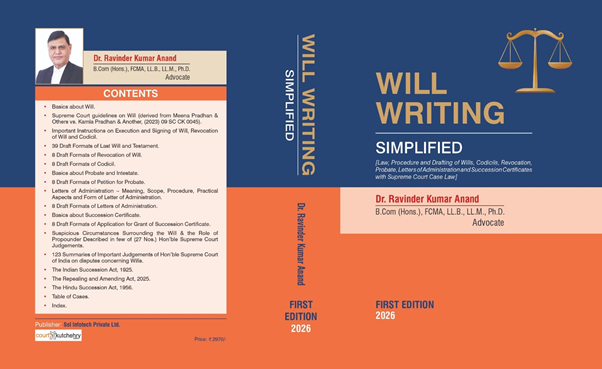
[📘 Legal professionals and students alike will benefit from Will Writing Simplified, which covers procedure and case law in detail.]
BUY NOW HERE:🔹 Amazon
BUY NOW HERE:🔹 Flipkart
What Is Frozen Sperm in Legal Terms?
- Frozen sperm refers to human reproductive genetic material cryopreserved in ART/IVF clinics for potential future use.
- Legally, it is not just a stored “thing.” It represents reproductive potential, implicating dignity, identity, lineage, and consent.
- The Delhi High Court emphasized that disputes over stored sperm involve public considerations, not merely private contracts.
Is Frozen Sperm Treated as Movable Property?
- Indian succession law does not provide a clear statutory answer.
- In one fact situation, the Delhi High Court held that sperm samples can constitute “property” or “estate” because they are capable of possession, use, and disposal.
- However, this classification remains contested and evolving.
- Treating genetic material as property raises difficult questions about inheritance, transfer, and exploitation.
- The Court itself urged the Union Health Ministry to frame clearer laws and guidelines.
Does “Property” Automatically Mean Succession Law Applies?
- Not necessarily. Even if sperm is called “property,” it does not mean it can be freely inherited or transferred like money or jewellery.
- Reproductive use is different from ownership. It triggers issues of consent, child welfare, and public policy.
- The Delhi High Court highlighted that consent of the donor and welfare of the unborn child are central considerations.
- The Court treated its role as protective, invoking the doctrine of parens patriae (guardian of those unable to protect themselves).
Significance of the Case
1. Ethical Dimensions
- Raises questions about whether human genetic material should ever be treated as property.
- Balances individual rights with broader social and moral concerns.
2. Legal Uncertainty
- Current laws do not clearly define the status of frozen sperm.
- Courts are filling the gap, but the Union Health Ministry has been asked to develop policy guidelines.
Also Read: Delhi High Court Orders MEA to Appoint Legal Firm for Celina Jaitly’s Brother Detained in UAE
3. Impact on ART/IVF Clinics
- Clinics must navigate unclear legal terrain when handling stored reproductive material.
- Clear rules would protect both patients and institutions.
Wider Implications
- Inheritance disputes: Could frozen sperm be claimed as part of an estate?
- Consent issues: What happens if the donor dies—can family members use the sperm?
- Child rights: Welfare of a child born from posthumous conception must be safeguarded.
- Policy development: India may need new legislation to address reproductive technologies and succession law.
Expert Reactions
- Legal scholars: Say the case highlights the urgent need for statutory clarity.
- Bioethicists: Warn against commodifying human genetic material.
- Family law practitioners: Note that succession disputes may increase as ART/IVF use grows.
Also Read: Supreme Court: Husband Must Maintain Ex-Wife Even If She Is Educated or Supported by Parents
Conclusion
The Delhi High Court’s handling of the frozen sperm issue marks a turning point in Indian law. By recognizing that reproductive material cannot be treated like ordinary property, the Court has opened a debate that touches on ethics, inheritance, and public policy. With the Union Health Ministry tasked to consider guidelines, India may soon see clearer laws governing the future of reproductive rights and genetic material.
GEO Keywords for Faster Searches
- Delhi High Court frozen sperm property case
- Union Health Ministry frozen sperm legal status
- Succession law genetic material India
- Frozen sperm inheritance rights India
- ART IVF frozen sperm legal framework
- Delhi HC reproductive material property ruling
- Consent and child welfare frozen sperm law