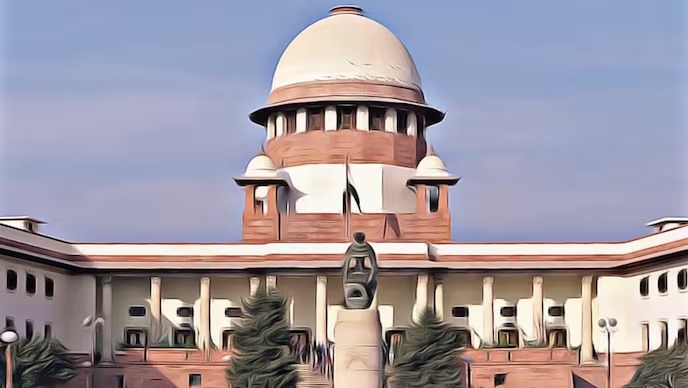
Supreme Court Flags Trial Court for Citing AI-Generated Fake Judgments, Calls It Judicial Misconduct
Bench warns against reliance on fabricated precedents
Court seeks responses from Attorney General, Solicitor General, and Bar Council of India
By Legal Reporter
New Delhi: March 02, 2026:
In a landmark development, the Supreme Court of India has strongly criticized a trial court for citing AI-generated fake judgments in its order, terming the act as judicial misconduct. The apex court observed that reliance on non-existent precedents undermines the credibility of the judicial process and erodes public confidence in the administration of justice.
Also Read: Delhi High Court Reduces Withholding Tax on US Firm Cvent Inc. from 15% to 2% Under Section 197
The case arose from a civil revision decided by the Andhra Pradesh High Court, where the trial court had relied on fabricated case laws that were later discovered to be generated by artificial intelligence tools.
Case Background
- The trial court in Andhra Pradesh cited judgments that did not exist in official legal records.
- Upon scrutiny, it was found that these were AI-generated fake judgments, mistakenly treated as authentic authorities.
- The matter reached the Supreme Court through a special leave petition (SLP).
- A bench comprising Justice Pamidighantam Sri Narasimha and Justice Alok Aradhe took serious exception to the conduct.
[Additional Resource]
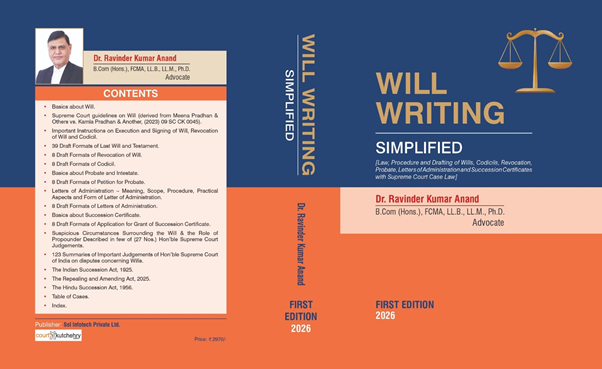
If you want practical guidance on drafting wills, codicils, and probate procedures, Will Writing Simplified is an invaluable resource. BUY NOW: Amazon 🔹 Flipkart
Court’s Observations
- Misconduct, Not Error: The Supreme Court clarified that citing fake judgments is not a mere error of reasoning but amounts to misconduct.
- Integrity of Judiciary: The bench emphasized that such practices strike at the very integrity of the adjudicatory process.
- Accountability: The court has sought responses from the Attorney General of India, the Solicitor General, and the Bar Council of India (BCI).
- Amicus Curiae: An amicus has been appointed to assist the court in examining the larger issue of AI misuse in judicial proceedings.
Relevant Laws and Rules
1. Contempt of Courts Act, 1971
- Judges are bound to uphold judicial integrity. Misconduct such as citing fake judgments can invite disciplinary action.
2. Judicial Ethics and Conduct Rules
- Judges must rely only on authentic precedents and verified sources.
- Misuse of unverified AI tools violates ethical standards.
3. Information Technology Act, 2000
- While not directly applicable to judicial conduct, provisions on fraud and misrepresentation highlight the dangers of AI misuse.
4. Bar Council of India Rules
- Lawyers and judges are expected to maintain professional responsibility and avoid reliance on fabricated materials.
Also Read: Bombay High Court: Women in De Facto Marriages Entitled to Maintenance Under DV Act
Broader Implications
- For Judiciary: The ruling sets a precedent that misuse of AI in judicial reasoning will be treated as misconduct.
- For Legal Professionals: Lawyers must ensure citations are authentic and verified from official sources.
- For Technology Use: Highlights the risks of unregulated AI tools in sensitive domains like law.
- For Policy Makers: Calls for guidelines on responsible AI use in courts and legal research.
Conclusion
The Supreme Court’s intervention in the AI-generated fake judgments case is a watershed moment in India’s judicial history. By terming the act as misconduct, the court has reinforced the principle that justice must rest on authentic and verified precedents.
Also Read: ITAT Rules No Fresh Reassessment Beyond Four Years if Facts Fully Disclosed
As AI tools become more common in legal research, this ruling serves as a reminder that technology must be used responsibly. The judiciary’s credibility depends on accuracy, integrity, and trust—values that cannot be compromised by fabricated citations.
Keywords for Faster Searches
- Supreme Court AI fake judgments India
- Trial court misconduct AI citations
- Judicial ethics AI misuse India
- Supreme Court ruling AI-generated case laws
- Bar Council of India AI guidelines
- AI in judiciary India rules
- Supreme Court Justice Narasimha AI case