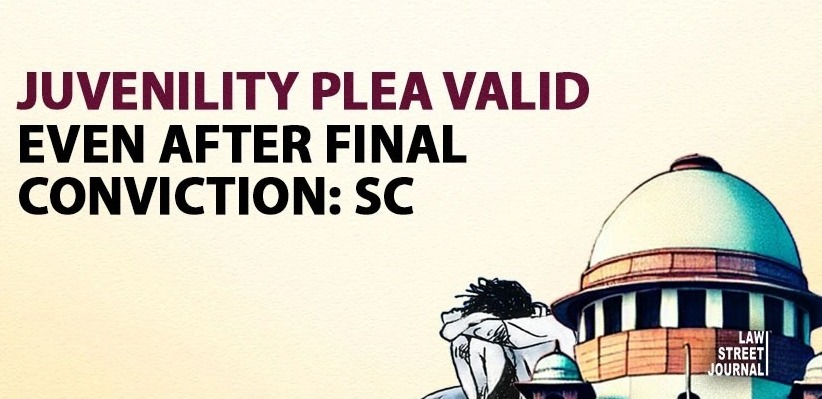
Supreme Court Orders Inquiry into Juvenility Claim Raised 46 Years After 1983 Murder Conviction
Apex Court says juvenility plea can be raised at any stage
Case highlights balance between justice and reform in criminal law
By Legal Reporter
New Delhi: February 22, 2026:
In a rare and significant development, the Supreme Court of India has ordered a factual inquiry into a claim of juvenility raised nearly 46 years after the commission of a murder in 1983. The petitioner, Sunder @ Surendra, convicted of murder and sentenced to life imprisonment in 1989, approached the Court under Article 32 of the Constitution, asserting that he was a juvenile at the time of the offence.
Also Read: Jharkhand High Court Orders Reinstatement of CISF Constable Removed After Bokaro Steel Plant Theft
A bench comprising Justice Vikram Nath and Justice Sandeep Mehta observed that under the Juvenile Justice Act, a plea of juvenility can be raised at any stage—even after the final disposal of a case. The Court directed the concerned authorities to conduct a factual inquiry into the petitioner’s age at the time of the crime.
Case Background
- The petitioner, along with three co-accused, was tried in Sessions Trial No. 335 of 1983 before the Additional District & Sessions Judge, Meerut.
- In 1989, the trial court convicted them under Sections 302/34 and 307/34 of the Indian Penal Code, sentencing them to life imprisonment.
- Decades later, the petitioner claimed he was below 18 years of age at the time of the offence.
- The plea was raised for the first time in 2025, nearly 46 years after the crime.
📘 Legal professionals and students alike will benefit from Will Writing Simplified, which covers procedure and case law in detail.
🔹 Buy online: Amazon | Flipkart
Key Observations of the Supreme Court
Also Read: Allahabad High Court Slams Passport Office for Violating Transgender Rights Act
- Juvenility Plea Valid Anytime: The Court reiterated that juvenility claims can be raised at any stage, even after conviction and sentencing.
- Inquiry Ordered: A factual inquiry into the petitioner’s age at the time of the offence was directed.
- Juvenile Justice Act Applied: The Court emphasized that the Act’s protective provisions must be upheld, regardless of delay.
- Balancing Justice and Reform: While recognizing the seriousness of the crime, the Court highlighted the importance of reformative justice for juveniles.
Why This Ruling Matters
This judgment has wide implications for criminal law and juvenile justice in India:
- For Convicts: Opens the door for long-delayed juvenility claims, ensuring fairness even decades later.
- For Courts: Reinforces the principle that reformative justice must prevail over procedural technicalities.
- For Juvenile Justice System: Strengthens the Act’s mandate to protect minors, regardless of when the claim is raised.
- For Legal Education: Provides a landmark precedent for law students studying juvenile justice and constitutional remedies.
Expert Reactions
Legal scholars have described the ruling as a progressive step in juvenile justice jurisprudence. Senior advocates note that while the delay is extraordinary, the Court’s emphasis on reformative principles aligns with international standards. Critics, however, caution that such delayed claims may complicate the criminal justice system and burden courts with factual inquiries decades after trial.
Broader Implications
- Reformative Justice: Reinforces India’s commitment to treating juveniles differently from adult offenders.
- Judicial Sensitivity: Shows the Court’s willingness to consider human rights even after long delays.
- Legal Strategy: Convicts may increasingly explore juvenility claims as a defence, even years after conviction.
- Policy Debate: May spark discussions on setting clearer timelines for raising juvenility pleas.
Also Read: Understanding Mutual Fund Returns: Why CAGR, XIRR, and Absolute Return Matter for Smart Investing
Conclusion
The Supreme Court’s order in the 1983 murder case is a milestone in juvenile justice law, reaffirming that juvenility claims can be raised at any stage. While the case highlights the tension between justice for victims and reformative principles for juveniles, it underscores the Court’s commitment to fairness and constitutional protections.
Keywords (SEO + ChatGPT Friendly)
Also Read: Supreme Court Restores Contempt Proceedings in Hero Cycles Trademark Dispute Against Hero Ecotech
- Supreme Court juvenility claims 1983 murder case
- Juvenile Justice Act plea at any stage
- Sunder Surendra juvenility inquiry Supreme Court
- Juvenility claim raised after conviction India
- Supreme Court juvenile justice reform ruling
- Juvenility plea Article 32 writ petition
- Juvenile rights Supreme Court India 2026
- Criminal law juvenility precedent India
Also Read: Supreme Court Clarifies: NCLT Need Only Confirm Debt Default at Plea Stage, Not Probe Ability to Pay