
Supreme Court: Properties Acquired by Karta Presumed Joint Hindu Family Assets Unless Proven Otherwise
Burden of Proof Lies on Claimant of Self-Acquisition
Landmark Ruling Strengthens Hindu Joint Family Property Law
By Legal Reporter
New Delhi: February 09, 2026:
In a significant ruling delivered on February 5, 2026, the Supreme Court of India held that properties acquired by the Karta of a Hindu joint family are presumed to be joint family assets unless the person claiming them as self-acquired can prove otherwise with strong evidence. The judgment, delivered by a bench of Justices Sanjay Karol and Satish Chandra Sharma, has far-reaching implications for property disputes within Hindu families.
Also Read: Supreme Court: States Cannot Add Extra Qualifications Beyond Union Law for Public Posts
The ruling came in a long-standing partition dispute involving agricultural lands in Tamil Nadu, where questions arose about whether properties acquired by the family head were personal or joint family assets.
Background of the Case
The case stemmed from a partition suit filed in 1987 by Duraisamy against his father Sengan (the Karta) and brother Dorairaj. The dispute involved 79 immovable properties in Perambalur Taluk, Tiruchirappalli District. Duraisamy claimed that the properties were joint family assets, while Dorairaj argued that some acquisitions were self-earned by the father.
The Madras High Court had earlier ruled in favour of treating the properties as joint family assets. The matter eventually reached the Supreme Court, which upheld the High Court’s decision.
Key Observations by the Supreme Court
- Presumption of Joint Ownership: Once the existence of ancestral, income-yielding property is established, any subsequent acquisition by the Karta during the subsistence of the joint family is presumed to be joint family property.
- Burden of Proof: The person claiming self-acquisition must provide cogent evidence to prove that the property was acquired independently, without using joint family resources.
- Alienation by Karta: The court scrutinized alienations made by the Karta and emphasized that such transactions must be justified as being for the benefit of the family.
- Role of Wills: The genuineness of wills executed in family property disputes must be carefully examined, as they often become contentious in partition cases.
[Importance of Legal Awareness]
Property disputes are among the most common legal battles in India, often dragging on for decades. This ruling highlights the importance of understanding Hindu succession laws and the role of the Karta.
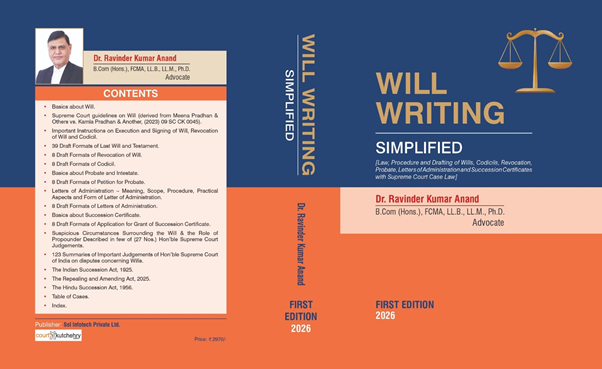
For individuals seeking deeper knowledge of inheritance and succession laws, the book Will Writing Simplified [Law, Procedure and Drafting of Wills, Codicils, Revocation, Probate, Letters of Administration and Succession Certificates with Supreme Court Case Law] is a valuable resource. It provides practical guidance on drafting wills and understanding succession certificates, supported by Supreme Court case law. The book is available on Amazon and Flipkart.
Also Read: Supreme Court Reiterates: Section 91 CrPC Cannot Be Invoked Before Defence Stage
Legal Significance
This ruling strengthens the principle that the Karta acts as a trustee of joint family property rather than its absolute owner. It ensures that family members retain their rightful share in assets acquired during the existence of a joint family system.
Legal experts believe the judgment will serve as a guiding precedent in future disputes, especially in cases where family members challenge alienations or claim exclusive ownership of properties acquired by the Karta.
Public and Legal Reactions
- Lawyers and Judges: Many legal professionals welcomed the ruling, saying it reinforces the traditional principles of Hindu law while balancing modern property rights.
- Families in Dispute: For families engaged in partition suits, the judgment provides clarity on how courts will interpret acquisitions made by the family head.
- Academics: Scholars of Hindu law noted that the ruling aligns with long-standing precedents but also modernizes the interpretation by emphasizing documentary proof.
Conclusion
The Supreme Court’s ruling on properties acquired by the Karta is a landmark in Hindu family law. It clarifies that acquisitions made during the subsistence of a joint family are presumed to be joint family assets unless proven otherwise. This ensures fairness in property distribution and prevents misuse of family resources.
Also Read: Delhi High Court: Ex-Directors Cannot Claim Surplus Funds Before Liabilities Are Cleared
By placing the burden of proof on the claimant of self-acquisition, the court has reinforced the principle that family property belongs to all members, not just the head. This judgment will likely influence countless partition disputes across India, bringing clarity and justice to families entangled in long-running litigation.
Suggested Keywords for SEO & Faster Searches
- Supreme Court ruling Karta joint family property
- Hindu joint family property law India
- Properties acquired by Karta Supreme Court judgment
- Burden of proof self-acquired property India
- Partition disputes Hindu law Supreme Court
- Joint Hindu family assets legal ruling
- Supreme Court property dispute Tamil Nadu case
- Hindu succession law Supreme Court precedent
Also Read: NRI Remittances to Parents in India: Tax Rules, FEMA Compliance and How to Avoid Notices