
Supreme Court Allows Single Insolvency Petition Against Linked Corporate Entities
Ruling Strengthens Creditor Rights Under IBC
Clarifies Law for Group Companies with Interconnected Dealings
By Our Legal Reporter
New Delhi: February 09, 2026:
The Insolvency and Bankruptcy Code (IBC), enacted in 2016, has transformed India’s corporate insolvency framework. However, questions have often arisen about whether creditors can file a single petition against multiple companies that are part of the same group or closely linked in business. In a recent ruling, the Supreme Court settled this issue, holding that a single petition is maintainable when corporate entities are intricately connected.
[RRR: Recommended Related Resource]
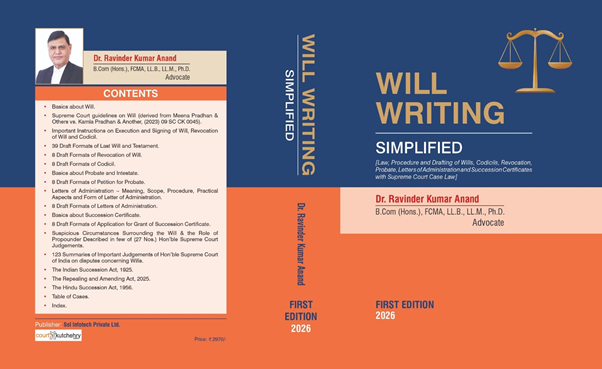
Legal professionals and students alike will benefit from Will Writing Simplified, which covers procedure and case law in detail. BUY NOW: Amazon 📘 Buy "Will Writing Simplified" online: 🔹 Flipkart
Case Background
- Dispute: Creditors filed a single insolvency petition against multiple companies that were part of the same group.
- Objection: The companies argued that each entity must be treated separately under the IBC.
- Supreme Court ruling: The Court held that if companies are financially and operationally intertwined, a single petition is valid.
Court’s Key Observations
- Interconnected operations: When companies share resources, finances, and management, they cannot be treated as isolated entities.
- Efficiency in insolvency: A single petition avoids duplication and ensures faster resolution.
- Creditor protection: Creditors should not be forced to file multiple petitions when the debt arises from linked entities.
- Legal principle: The IBC must be interpreted to achieve its objective of timely resolution and maximization of asset value.
Impact of the Ruling
- For creditors: Simplifies the process of initiating insolvency against group companies.
- For companies: Group entities must be cautious about shared financial arrangements.
- For judiciary: Reduces multiplicity of proceedings and ensures consistency in outcomes.
Why This Ruling Matters
- Legal clarity: Removes ambiguity about group insolvency under the IBC.
- Strengthens creditor rights: Ensures creditors can pursue recovery without procedural hurdles.
- Corporate governance: Encourages companies to maintain transparent financial structures.
Broader Context
- Global practice: Many jurisdictions, including the EU, recognize group insolvency proceedings.
- Indian reforms: This ruling aligns India’s insolvency framework with international standards.
- Policy impact: May lead to future amendments in the IBC to formally codify group insolvency.
Also Read: Delhi High Court Orders MEA to Appoint Legal Firm for Celina Jaitly’s Brother Detained in UAE
Practical Takeaways
- Creditors can file single petitions: When companies are intricately linked, one petition suffices.
- Companies must maintain clear records: To avoid liability, group entities should separate finances and operations.
- Legal advisors should guide clients: On structuring corporate groups to minimize insolvency risks.
In summary, the Supreme Court’s ruling that a single insolvency petition is maintainable against intricately linked corporate entities marks a significant step in strengthening India’s insolvency regime. It ensures creditor protection, reduces procedural delays, and aligns Indian law with global best practices.
Keywords for SEO & Faster Searches
Also Read: Supreme Court: Husband Must Maintain Ex-Wife Even If She Is Educated or Supported by Parents
- Supreme Court IBC single insolvency petition
- Group insolvency India corporate law
- Linked corporate entities insolvency ruling
- Creditor rights under IBC Supreme Court
- Insolvency and Bankruptcy Code group companies