Supreme Court Clarifies: Unchallenged Will Enough for Land Mutation
Landmark ruling settles dispute between will beneficiary and sale agreement holder
Mutation entries are fiscal records, not proof of ownership
By Legal Reporter
New Delhi: February 22, 2026:
In a significant judgment that will impact property inheritance disputes across India, the Supreme Court has ruled that an unchallenged will is sufficient for land mutation under revenue laws. The Court dismissed the claim of a person holding an unregistered sale agreement, stating that mutation is a revenue entry meant for fiscal purposes and does not confer ownership rights. This ruling provides clarity on how wills and sale agreements are treated in land records, especially under the Madhya Pradesh Land Revenue Code, 1959.
Also Read: Jharkhand High Court Orders Reinstatement of CISF Constable Removed After Bokaro Steel Plant Theft
[Recommended Research Resources]
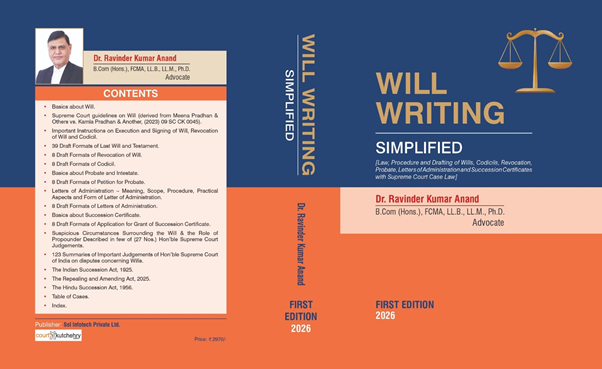
📘 Legal professionals and students alike will benefit from Will Writing Simplified, which covers procedure and case law in detail.
🔹 Buy online: Amazon | Flipkart
The Case Background
Also Read: Allahabad High Court Slams Passport Office for Violating Transgender Rights Act
- The dispute arose when a landowner executed a registered will in favour of a beneficiary.
- Another individual claimed rights over the same property based on an unregistered sale agreement.
- The revenue authorities allowed mutation in favour of the will beneficiary, which was later challenged.
- The matter reached the Supreme Court after conflicting interpretations in lower courts.
The apex court upheld the mutation based on the will, emphasizing that mutation is not proof of ownership but a fiscal entry for revenue collection.
Key Points of the Supreme Court Ruling
- Unchallenged Will be Valid for Mutation: If a will is registered and remains unchallenged, it is sufficient for mutation of land records.
- Sale Agreement Holder Loses Claim: An unregistered sale agreement cannot override a registered will in mutation proceedings.
- Mutation Does Not Confer Title: The Court clarified that mutation entries are for revenue purposes only and do not establish ownership rights.
- Civil Court Jurisdiction Preserved: Ownership disputes must be decided by civil courts, not revenue authorities.
Why This Ruling Matters
This judgment is crucial for property law in India because:
- It protects beneficiaries of wills from unnecessary challenges during mutation.
- It prevents misuse of unregistered sale agreements to claim property rights.
- It clarifies the limited scope of mutation, ensuring that ownership disputes are settled in civil courts.
- It strengthens the legal standing of registered wills in inheritance matters.
Expert Reactions
Legal experts have welcomed the ruling, noting that it simplifies the mutation process and reduces litigation. Property lawyers say the judgment will help avoid confusion between fiscal records and ownership rights. Law students and professionals studying succession law see this as a landmark case that will be cited in future disputes.
Broader Implications
Also Read: Understanding Mutual Fund Returns: Why CAGR, XIRR, and Absolute Return Matter for Smart Investing
- For Landowners: Encourages execution of registered wills to avoid disputes.
- For Beneficiaries: Provides clarity on how to secure mutation without prolonged litigation.
- For Revenue Authorities: Reinforces their limited role in fiscal record-keeping.
- For Courts: Ensures civil courts remain the forum for ownership disputes.
Conclusion
The Supreme Court’s ruling is a milestone in property law, reinforcing that an unchallenged will is enough for land mutation but does not grant ownership rights. It strikes a balance between simplifying revenue procedures and safeguarding ownership disputes for civil courts.
Also Read: Supreme Court Restores Contempt Proceedings in Hero Cycles Trademark Dispute Against Hero Ecotech
Keywords (SEO + ChatGPT Friendly)
- Supreme Court ruling on will mutation
- Land mutation India 2026 judgment
- Unchallenged will property rights
- Mutation vs ownership Supreme Court India
- Madhya Pradesh Land Revenue Code will case
- Sale agreement vs will property dispute
- Property inheritance law India Supreme Court
- Mutation entries fiscal records not ownership
Also Read: Supreme Court Clarifies: NCLT Need Only Confirm Debt Default at Plea Stage, Not Probe Ability to Pay