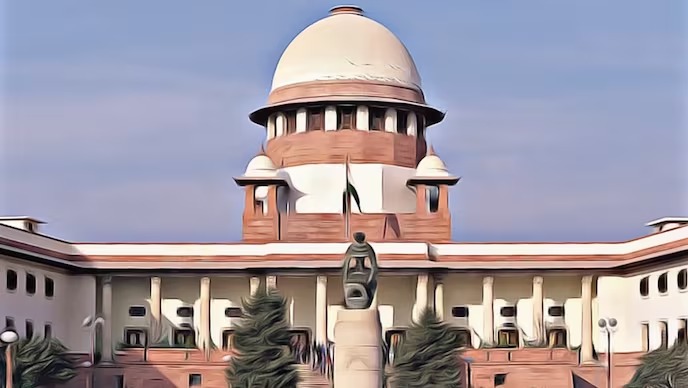
Supreme Court Allows Regularization of SC/ST Occupation on Private Land Under Section 123 of U.P. Zamindari Abolition Act
Top Court upholds statutory protection for marginalized communities
Judges clarify scope of Section 123 in land settlement disputes
By Legal Reporter
New Delhi: February 26, 2026:
In a landmark judgment, the Supreme Court of India has ruled that unauthorized occupation of private land by members of the Scheduled Caste (SC) and Scheduled Tribe (ST) communities can be regularized under Section 123 of the Uttar Pradesh Zamindari Abolition and Land Reforms Act, 1950 (U.P. Z.A. & L.R. Act).
Also Read: Anthropic Accuses Chinese AI Labs of Distillation Attacks on Claude Models
The bench, comprising Justice S.V.N. Bhatti and Justice R. Mahadevan, emphasized that the statute creates a “legal fiction” deeming the land settled with house owners in possession by the cut-off date, regardless of whether the land was later declared non-agricultural. This ruling is expected to have far-reaching implications for land rights and social justice in Uttar Pradesh.
Background of the Case
- The dispute involved private land occupied by SC/ST families in Uttar Pradesh.
- Authorities had questioned whether such occupation could be regularized under the U.P. Z.A. & L.R. Act.
- Section 123 of the Act provides for settlement of land with persons in possession of houses built on it by a specified cut-off date.
- The matter reached the Supreme Court after conflicting interpretations by lower courts and revenue authorities.
[Additional Resource]
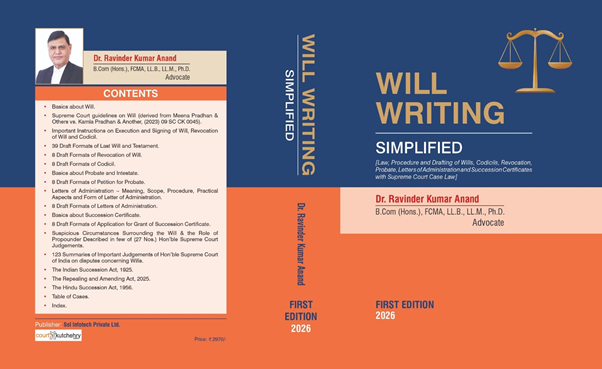
If you want practical guidance on drafting wills, codicils, and probate procedures, Will Writing Simplified is an invaluable resource. BUY TODAY: Amazon 🔹 Flipkart
Supreme Court’s Observations
- Legal fiction applies: The Court held that Section 123 creates a statutory presumption that land occupied by SC/ST communities for housing purposes is deemed settled with them.
- Cut-off date crucial: Occupation prior to the cut-off date is sufficient to establish settlement rights, even if the land was later classified differently.
- Social justice dimension: The ruling reinforces the constitutional mandate to protect marginalized communities and ensure housing security.
- Private land included: The Court clarified that even private land, if occupied by SC/ST families under the conditions of Section 123, can be regularized.
Also Read: Visa-Free Travel Explained: Why It Doesn’t Always Guarantee Entry
Why This Judgment Matters
- For SC/ST communities: It provides legal protection and recognition of housing rights, reducing vulnerability to eviction.
- For landowners: It clarifies the scope of regularization, ensuring disputes are resolved within statutory limits.
- For governance: The ruling strengthens the framework for balancing private property rights with social justice obligations.
Expert Views
Legal experts have hailed the judgment as a progressive step toward inclusive land reforms.
- Advocates specializing in land law note that the ruling ensures marginalized communities are not left homeless due to technicalities.
- Social justice commentators emphasize that the decision aligns with the constitutional vision of equality and dignity for disadvantaged groups.
Broader Implications
- Housing security: The ruling will help stabilize housing rights for SC/ST families across Uttar Pradesh.
- Reduced litigation: Clear interpretation of Section 123 will prevent prolonged disputes in revenue courts.
- Policy impact: The judgment may influence future amendments to land reform laws, ensuring stronger protection for vulnerable groups.
Also Read: Supreme Court Rules Rooh Afza is a Fruit Drink, Attracts Only 4% VAT
Conclusion
The Supreme Court’s ruling on Section 123 of the U.P. Z.A. & L.R. Act marks a significant step in protecting the housing rights of SC/ST communities. By recognizing the statutory regularization of unauthorized occupation, the Court has reinforced the principle that social justice must prevail over technicalities of land classification.
This judgment will serve as a precedent for similar disputes, ensuring that marginalized communities are not deprived of shelter and dignity.
Keywords for SEO & Faster Searches
Also Read: Kerala High Court: Uploading GST Orders on Portal Constitutes Valid Service
- Supreme Court SC/ST land occupation ruling
- Section 123 UP Zamindari Abolition Act
- Unauthorized occupation regularization Supreme Court
- SC/ST housing rights India
- Supreme Court land settlement judgment
- Uttar Pradesh land reforms Supreme Court case
- Legal fiction Section 123 land rights
- Supreme Court social justice land ruling
Also Read: Supreme Court to Examine Condonation of 30-Month ITR Delay