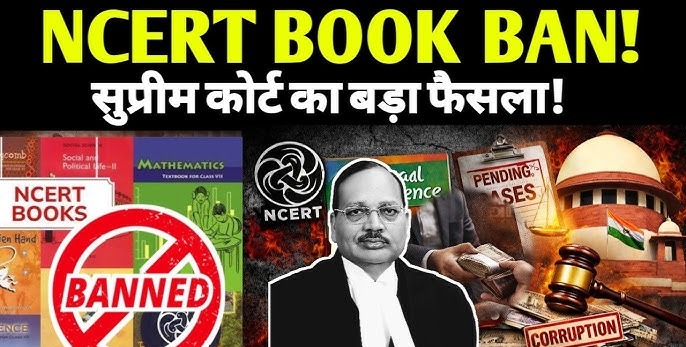
Supreme Court Bans NCERT Class 8 Textbook Over ‘Judiciary Corruption’ Chapter, Orders Accountability
Top Court imposes blanket ban on book, directs seizure of copies
NCERT apologises, promises revision before next academic session
By Legal Reporter
New Delhi: February 26, 2026:
In a dramatic intervention, the Supreme Court of India has imposed a blanket ban on the Class 8 NCERT Social Science textbook that contained a controversial chapter referring to “corruption in the judiciary.” The Court, acting suo motu, ordered the seizure of all physical copies and directed the removal of digital versions from official websites.
Also Read: Anthropic Accuses Chinese AI Labs of Distillation Attacks on Claude Models
The bench expressed strong displeasure, calling the inclusion of such content a “deep-rooted conspiracy” to undermine public trust in the judiciary. Notices have been issued to senior officials of the Ministry of Education and the NCERT Director, asking why contempt proceedings should not be initiated against them.
Background of the Case
- Reports first surfaced in February 2026 that the new NCERT Class 8 textbook contained a section on corruption in the judiciary.
- The Supreme Court registered a suo motu case on February 25, 2026, after media coverage highlighted the issue.
- On February 26, the Court ordered a complete ban on the book’s publication, printing, and digital dissemination.
- The NCERT later issued an apology, stating that the chapter would be rewritten in consultation with appropriate authorities before the 2026–27 academic session.
Supreme Court’s Observations
- Judiciary cannot be maligned: The Court stressed that unfounded allegations in textbooks could erode public confidence in the judicial system.
- Accountability of officials: Show-cause notices were issued to NCERT and Education Ministry officials for possible contempt.
- Immediate compliance: Authorities were directed to seize physical copies and remove online versions.
- Unqualified apology required: The Solicitor General informed the Court that NCERT would issue an unconditional apology.
NCERT’s Response
- NCERT withdrew the textbook from circulation.
- It promised to revise the chapter in consultation with experts and government authorities.
- The council acknowledged the content was “inappropriate” and assured corrective measures.
Also Read: Visa-Free Travel Explained: Why It Doesn’t Always Guarantee Entry
[Additional Resource]
If you want practical guidance on drafting wills, codicils, and probate procedures, Will Writing Simplified is an invaluable resource. BUY HERE NOW: Amazon 🔹 Flipkart
Why This Case Matters
- For students: Ensures that textbooks remain accurate and free from controversial or misleading content.
- For judiciary: Reinforces the importance of protecting institutional credibility.
- For education policy: Highlights the need for stronger vetting of curriculum content before publication.
Expert Views
- Legal experts argue that while criticism of institutions is part of democracy, textbooks must be carefully curated to avoid undermining constitutional bodies.
- Education specialists emphasize the importance of transparency in curriculum development and the need for consultation with stakeholders.
- Social commentators note that the controversy reflects broader tensions between free expression and institutional respect.
Broader Implications
- Curriculum reform: The case may lead to stricter oversight of NCERT publications.
- Public trust: Reinforces the judiciary’s role as a pillar of democracy.
- Policy precedent: Sets an example for how courts may intervene in education matters when institutional integrity is at stake.
Also Read: Supreme Court Rules Rooh Afza is a Fruit Drink, Attracts Only 4% VAT
Conclusion
The Supreme Court’s ban on the NCERT Class 8 textbook over references to judicial corruption is a landmark case in balancing education, free expression, and institutional respect. By ordering seizure of copies and demanding accountability, the Court has sent a strong message that public trust in the judiciary must not be compromised.
NCERT’s apology and promise to revise the chapter highlight the need for greater care in curriculum design. As India prepares for the next academic session, this case will serve as a reminder that textbooks must educate responsibly while safeguarding democratic institutions.
Keywords for SEO & Faster Searches
Also Read: Kerala High Court: Uploading GST Orders on Portal Constitutes Valid Service
- Supreme Court NCERT Class 8 textbook ban
- Judiciary corruption chapter NCERT
- NCERT apology Supreme Court ruling
- Suo motu case NCERT textbook India
- Education Ministry contempt notice NCERT
- Supreme Court textbook ban February 2026
- NCERT curriculum controversy judiciary
- Judicial integrity Supreme Court India
Also Read: Supreme Court to Examine Condonation of 30-Month ITR Delay