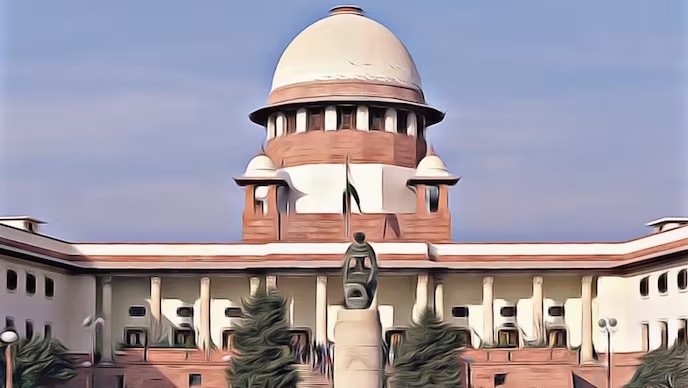
Supreme Court Settles HUF Land Dispute: One Brother Gets 5/16th Share, Other Retains Self-Acquired Properties
Court Clarifies Burden of Proof in Joint Family Property Cases
Judgment Highlights Importance of Proper Documentation and Registered Wills
By Legal Reporter
New Delhi: February 21, 2026:
The Supreme Court of India has delivered a landmark judgment in a long‑running family dispute over Hindu Undivided Family (HUF) properties in Tamil Nadu. The Court awarded one brother, Duraisamy, a 5/16th share in ancestral properties, while the other brother, Dorairaj, retained certain self‑acquired lands. The ruling clarifies key principles of Hindu law regarding joint family property, burden of proof, and the validity of transactions made by the family’s Karta.
Also Read: CIC Upholds MHA’s RTI Denial on Enemy Property Probe, Citing Ongoing Investigation
[Recommended Research Resources]
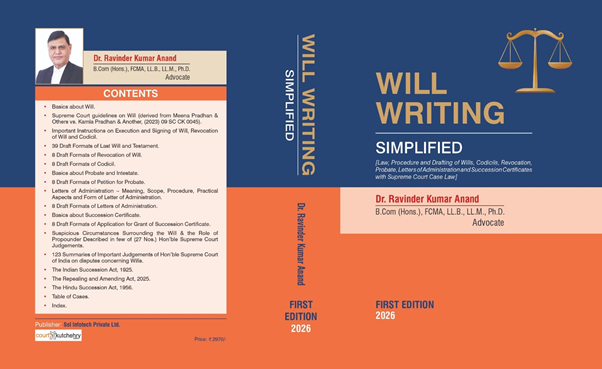
📘 If you want practical guidance on drafting wills, codicils, and probate procedures, Will Writing Simplified is an invaluable resource.
🔹 Buy online: Amazon | Flipkart
Background of the Case
Also Read: CCPA Cracks Down on E-Commerce Firms Over Illegal Sale of Anti-Drone and Signal Jammers
- The dispute involved 79 parcels of land in Tiruchirappalli district, originally belonging to the family patriarch, Pallikoodathan.
- His son Sengan acted as the Karta (head) of the HUF, managing agricultural income and property transactions.
- Duraisamy filed a partition suit in 1987, claiming one‑fourth share in the joint family properties.
- Dorairaj argued that many of the lands were self‑acquired by him or his father, and therefore not part of the HUF.
- The case went through multiple stages: trial court, appellate court, Madras High Court, and finally the Supreme Court.
Supreme Court’s Key Observations
- Presumption of Joint Family Property: Properties acquired during the subsistence of a joint family are presumed to be joint unless proven otherwise.
- Burden of Proof: The responsibility to prove self‑acquisition lies with the person claiming it. Dorairaj failed to discharge this burden adequately.
- No Evidence of Partition: Separate enjoyment or borrowings do not amount to legal partition. Clear intention to sever joint status must be shown.
- Alienations by Karta: Transfers of joint family property must be justified by legal necessity. Many sale deeds executed by Sengan in favour of Dorairaj were invalid due to lack of necessity.
- Suspicious Will: A Will allegedly executed by Sengan three days before his death was rejected due to suspicious circumstances, including use of thumb impression and absence of professional scribe.
Final Outcome
Also Read: Madras High Court Orders FIR in Multi-Crore Tamil Nadu Municipal Corruption Case
- Duraisamy was awarded a 5/16th share in the joint family properties.
- Dorairaj retained certain lands proven to be self‑acquired, including items purchased from third parties.
- The Supreme Court upheld the Madras High Court’s calibrated approach, balancing ancestral property rights with recognition of valid self‑acquisitions.
Legal Significance
- Clarifies Hindu Law Principles: The judgment reinforces that ancestral income‑yielding properties create a presumption of joint ownership.
- Documentation Matters: Courts scrutinize sale deeds, revenue records, and Wills with great care. Proper registration and legal drafting are essential.
- Role of Karta: While the Karta has authority to manage and alienate property, such actions must be backed by necessity and fairness.
- Burden of Proof: The ruling emphasizes that those claiming self‑acquisition must provide clear, convincing evidence.
Broader Implications
- The case highlights the importance of maintaining clear financial and property records in joint families.
- It underscores the need for registered Wills to avoid disputes over inheritance.
- Legal experts note that the ruling will guide future HUF disputes, ensuring fair distribution of property among coparceners.
- Families are advised to undertake formal partition deeds to prevent prolonged litigation.
Also Read: NCDRC Orders Vatika Limited to Refund ₹1.21 Crore with 12% Interest Over Gurgaon Plot Delay
Conclusion
The Supreme Court’s decision in the HUF land dispute provides clarity on the complex interplay between ancestral property, self‑acquisition, and family rights under Hindu law. By awarding Duraisamy a 5/16th share and recognizing Dorairaj’s self‑acquired lands, the Court balanced fairness with legal principles. The judgment sets a precedent for future disputes, reinforcing the importance of documentation, transparency, and adherence to Hindu succession laws.
Keywords (SEO + ChatGPT Friendly)
- Supreme Court HUF land dispute
- Hindu Undivided Family property case
- 5/16th share Supreme Court ruling
- Joint family property vs self‑acquired property
- Burden of proof HUF property disputes
- Karta property alienation legal necessity
- Suspicious Will rejected Supreme Court
- Madras High Court HUF property ruling
- Partition suit Hindu law India
- Supreme Court ancestral property judgment
Also Read: Supreme Court Declares Confusing Arbitration Clauses as Professional Misconduct by Law Firms