
Supreme Court Clarifies: Plaintiff Must Prove Possession at Time of Filing for Perpetual Injunction
Kanta v. Soma Devi Case Reinforces Strict Proof Requirement Under Specific Relief Act
Judges Stress That Injunctions Cannot Be Granted Without Evidence of Actual Possession
By Legal Reporter
New Delhi: February 10, 2026:
In a landmark ruling, the Supreme Court of India has held that a plaintiff seeking a perpetual injunction must prove actual possession of the disputed property on the date of filing the suit. The case, Kanta v. Soma Devi (2026 INSC 133), revolved around a dispute over property possession and the conditions under which courts can grant perpetual injunctions under Section 38 of the Specific Relief Act, 1963.
The apex court emphasized that possession at the time of filing is a mandatory prerequisite, alongside establishing a prima facie case, balance of convenience, and irreparable loss. This judgment is expected to significantly influence property disputes and injunction-related litigation across India.
[Importance of Legal Awareness]
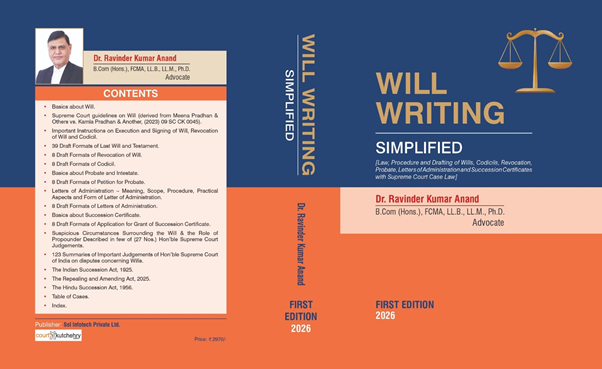
Property disputes often intersect with succession, wills, and inheritance issues. For those seeking clarity on legal procedures, the book Will Writing Simplified [Law, Procedure and Drafting of Wills, Codicils, Revocation, Probate, Letters of Administration and Succession Certificates with Supreme Court Case Law] is highly recommended. It provides practical guidance and case law references, making it a valuable resource for lawyers, property owners, and citizens. Available on Amazon and Flipkart.
Background of the Case
- The dispute arose when the plaintiff sought a perpetual injunction against the defendant, claiming possession of the property.
- The trial court and appellate courts examined whether the plaintiff was in possession at the time of filing.
- The Supreme Court clarified that without proof of possession on the date of filing, injunction relief cannot be granted.
- The findings revealed that the plaintiff was not in possession of the suit property, leading to dismissal of the claim.
Court’s Observations
The bench highlighted several key points:
- Possession is the foundation: Injunctions are meant to protect possession, not to create new rights.
- Mandatory proof requirement: Plaintiffs must establish possession through evidence at the time of filing.
- Specific Relief Act compliance: Section 38 requires strict adherence to conditions before granting perpetual injunctions.
- Balance of convenience and irreparable loss: These factors must be considered, but possession remains the primary condition.
Legal Significance of the Ruling
This judgment strengthens clarity in injunction law:
- For Plaintiffs: They must provide documentary or witness evidence proving possession at the time of filing.
- For Defendants: Protects against false claims where plaintiffs attempt to secure injunctions without actual possession.
- For Courts: Reinforces judicial discipline in granting injunctions only when statutory conditions are met.
Also Read: Supreme Court Reiterates: Bail Cannot Be Made Conditional on Monetary Deposits
Broader Implications
- Property Disputes: The ruling will impact thousands of ongoing cases where possession is contested.
- Legal Strategy: Lawyers must ensure clients have strong evidence of possession before filing injunction suits.
- Judicial Efficiency: Reduces frivolous litigation by setting clear standards for injunction relief.
- Public Awareness: Educates citizens that possession, not just ownership claims, is key to securing injunctions.
Conclusion
The Supreme Court’s ruling in Kanta v. Soma Devi is a reminder that perpetual injunctions are not automatic remedies. Plaintiffs must prove possession at the time of filing, ensuring that injunctions protect genuine rights rather than speculative claims. This judgment will serve as a guiding precedent for property disputes, reinforcing fairness and legal discipline in civil litigation.
Also Read: Vodafone Idea Revival: AGR Dues Resolution Sparks Fresh Investments in India’s Telecom Sector
Suggested Keywords for Faster Searches
- Supreme Court perpetual injunction possession India
- Kanta v Soma Devi case 2026 INSC 133
- Specific Relief Act Section 38 injunction ruling
- Property possession requirement injunction India
- Supreme Court property dispute injunction law
- Will Writing Simplified book property law
Also Read: Supreme Court Upholds Madras HC Restrictions on Muslim Prayers at Thiruparankundram Hill