
Supreme Court Clarifies: Possession Alone Cannot Finalize Property Sale Without a Registered Sale Deed
Tenant’s Payment of ₹6.5 Lakh Recognized, But Ownership Still Hinges on Proper Legal Documentation
SC Ruling Strengthens Landlord Rights and Reinforces Importance of Sale Deeds in Property Transactions
By Legal Reporter
New Delhi: February 10, 2026:
In a landmark judgment, the Supreme Court of India has ruled that mere possession of a property, even after partial payment under a sale agreement, does not amount to ownership unless a registered sale deed is executed. The case involved a tenant who paid ₹6.5 lakh to purchase his landlady’s property, but the apex court clarified that possession arising from tenancy cannot be equated with ownership rights. This ruling has significant implications for property buyers, landlords, and tenants across India, reinforcing the critical role of sale deeds in real estate transactions.
[Recommended Resource for Legal Understanding]
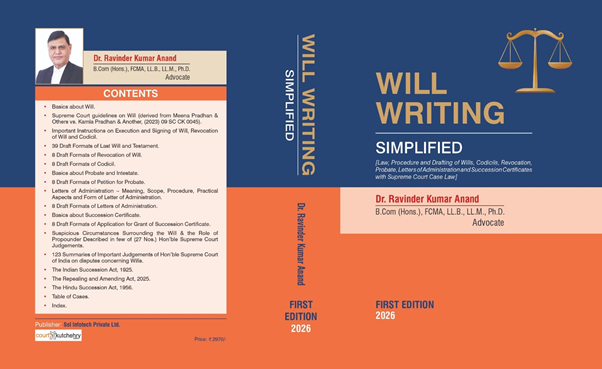
For readers seeking deeper insights into wills, and succession, the book Will Writing Simplified [Law, Procedure and Drafting of Wills, Codicils, Revocation, Probate, Letters of Administration and Succession Certificates with Supreme Court Case Law] is a valuable resource. It provides practical guidance and case law references, making it essential for anyone dealing with property and inheritance matters. Available on Amazon and Flipkart.
Background of the Case
- A tenant entered into an agreement with his landlady to purchase her property.
- He paid ₹6.5 lakh as part of the transaction and continued to occupy the premises.
- The dispute arose when ownership was contested, with the tenant claiming rights based on possession and partial payment.
- The Supreme Court admitted the sale agreement as evidence but clarified that ownership cannot be transferred without a registered sale deed.
Supreme Court’s Observations
- Possession must stem from the sale agreement itself: If possession arises from tenancy, it cannot be treated as ownership.
- Sale agreement is admissible evidence: While the agreement can be considered in court, it does not by itself confer ownership.
- Registered sale deed is mandatory: Without registration, the transfer of property remains incomplete.
- Tenant cannot claim ownership through adverse possession: The court reiterated that long-term occupation does not make a tenant the owner.
Legal Significance of the Ruling
This judgment strengthens the position of landlords and clarifies misconceptions around tenancy and ownership. It ensures that:
- Tenants cannot misuse possession to claim ownership.
- Buyers must complete transactions with proper documentation.
- Courts will uphold sale deeds as the ultimate proof of ownership.
Broader Implications for Real Estate
Also Read: Supreme Court Reiterates: Bail Cannot Be Made Conditional on Monetary Deposits
- For Buyers: Always insist on a registered sale deed to secure ownership.
- For Landlords: The ruling protects against false claims by tenants.
- For Tenants: Occupation, even with partial payment, does not equate to ownership.
- For Legal Practitioners: The case sets a precedent for future disputes involving tenancy and sale agreements.
Importance of Proper Documentation
Property transactions in India often face disputes due to informal agreements and lack of registration. This ruling highlights the dangers of relying solely on possession or unregistered agreements. Buyers and sellers must ensure:
- Execution of a registered sale deed.
- Payment of proper stamp duty.
- Compliance with local property laws.
Conclusion
The Supreme Court’s ruling is a reminder that property ownership in India is governed strictly by law and documentation. Possession, even with partial payment, cannot replace the legal requirement of a registered sale deed. This judgment not only protects landlords but also guides buyers and tenants towards lawful practices in property transactions.
Also Read: Vodafone Idea Revival: AGR Dues Resolution Sparks Fresh Investments in India’s Telecom Sector
Suggested Keywords for Faster Searches
- Supreme Court property ruling India
- Tenant sale agreement possession
- Sale deed vs possession SC judgment
- Property ownership legal documentation India
- Adverse possession tenant rights India
- Will Writing Simplified book property law
Also Read: Supreme Court Upholds Madras HC Restrictions on Muslim Prayers at Thiruparankundram Hill