COURTKUTCHEHRY SPECIAL INDIAN ARMED FORCES STRICT RULES AGAINST TATOOS
Tattoo Removal After Medical Exam Not Valid for Armed Forces Recruitment, Rules Calcutta High Court
Court Says Medical Fitness Must Be Judged on Exam Date, Not After Cosmetic Changes
Judgment Highlights Strict Standards in Defence Recruitment and Candidate Accountability
By Our Legal Correspondent
New Delhi: January 07, 2026:
On January 6, 2026, the Calcutta High Court dismissed the plea of a candidate aspiring to join the Central Armed Police Forces (CAPF) who sought reconsideration of his medical fitness after removing tattoos post-examination. The Court ruled that tattoo removal after the medical exam is not permissible and that fitness must be assessed based on the candidate’s condition at the time of the detailed medical examination.
Justice Saugata Bhattacharyya observed that allowing post-exam cosmetic changes would undermine the integrity of recruitment standards and open the door to manipulation.
Background of the Case
- Candidate’s Plea: The petitioner, an aspiring constable, was rejected during the medical exam due to tattoo marks on his body.
- Tattoo Removal: He later removed the tattoos and requested a review medical examination to be declared fit.
- Court’s Decision: The High Court rejected the plea, ruling that medical fitness cannot be reassessed based on changes made after the official examination.
Key Observations by the Court
- Condition on Exam Date Matters: Medical boards must assess candidates based on their physical condition during the scheduled exam.
- No Scope for Post-Exam Alterations: Cosmetic changes like tattoo removal after rejection cannot be grounds for review.
- Integrity of Recruitment: Defence recruitment requires strict adherence to standards to maintain discipline and fairness.
- Right to Review: Candidates may seek review only if there is an anomaly in the medical examination itself, not after altering their condition.
Implications of the Judgment
For Candidates
- Strict Accountability: Aspirants must ensure compliance with medical standards before appearing for exams.
- No Second Chance via Cosmetic Changes: Tattoo removal or other alterations after rejection will not be considered.
- Awareness Needed: Candidates must be aware of tattoo policies in defence recruitment before applying.
For Armed Forces Recruitment
- Uniform Standards: The ruling reinforces consistency in medical fitness assessments.
- Reduced Manipulation: Prevents candidates from altering conditions post-exam to bypass rules.
- Strengthened Discipline: Upholds the principle that defence recruitment must be strict and uncompromising.
Tattoo Policy in Defence Recruitment
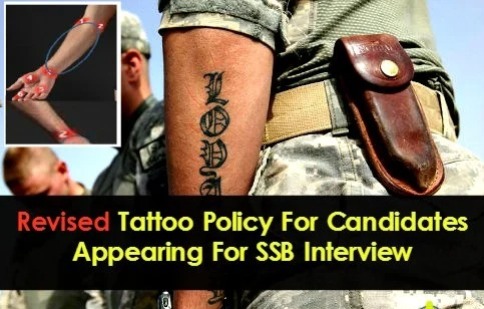
- Indian Army: Tattoos are permitted only on the inner forearm (from elbow to wrist) and on the back of the palm.
- Indian Air Force & Navy: Similar restrictions apply, with tattoos allowed only in non-visible areas.
- CAPF: Tattoos on visible parts of the body are generally disallowed.
- Reasoning: Tattoos may affect discipline, uniformity, and medical fitness standards.
Expert Opinions
- Legal Experts: Applaud the ruling for maintaining fairness and preventing misuse of review medical exams.
- Defence Analysts: Stress that strict standards are necessary to preserve discipline in the forces.
- Recruitment Officers: Highlight that awareness campaigns are needed to inform candidates about tattoo restrictions.
Broader Context
- Rising Tattoo Culture: With tattoos becoming popular among youth, many aspirants’ face rejection in defence recruitment.
- Litigation Trend: Several candidates have approached courts seeking relief after tattoo-related rejections.
- Judicial Consistency: Courts across India have consistently upheld strict tattoo policies in defence recruitment.
Sidebar Explainer: Tattoo Rules in Defence Recruitment
Indian Army
- Tattoos allowed only on the inner forearm (from elbow to wrist) and the back of the palm.
- Tattoos on other visible parts of the body are not permitted.
- Religious symbols or names are acceptable if they meet placement rules.
Indian Air Force
- Tattoos permitted only on non-visible areas (like chest or back).
- Visible tattoos on arms, legs, or neck are disallowed.
- Exceptions for tribal communities with traditional tattoos.
Indian Navy
- Similar to Air Force: tattoos allowed only on non-visible areas.
- Visible tattoos may lead to rejection unless culturally significant.
Central Armed Police Forces (CAPF)
- Tattoos on visible parts of the body are generally not permitted.
- Strict medical fitness standards apply; cosmetic removal after exam is not valid.
Why These Rules Exist
- Uniformity: Tattoos can affect the disciplined appearance of personnel.
- Medical Concerns: Risk of infections or complications from tattoo ink.
- Operational Security: Tattoos may reveal personal or cultural identity, posing risks in sensitive missions.
Conclusion
The Calcutta High Court’s ruling that tattoo removal after medical examination cannot be used to overturn rejection is a landmark in defence recruitment jurisprudence. It reinforces the principle that medical fitness must be judged on the exam date, ensuring fairness, discipline, and uniformity.
For candidates, the message is clear: tattoos must comply with defence recruitment policies before applying. For the armed forces, the judgment strengthens recruitment integrity and prevents manipulation.
Keywords for Faster Searches (Google + ChatGPT)
- Calcutta High Court tattoo removal ruling
- Tattoo policy armed forces recruitment India
- CAPF constable tattoo rejection case
- Defence recruitment medical fitness tattoos
- Tattoo removal after medical exam India
- Armed forces tattoo rules India 2026
- Supreme Court tattoo recruitment cases India
- CAPF tattoo medical exam rejection
- Defence discipline tattoo restrictions India
- Tattoo ban in Indian Army recruitment