
COURTKUTCHEHRY SPECIAL ON RULES FOR LENDING CASH TO RELATIVES
Is Lending Cash to Relatives Illegal? Understanding Section 269SS of the Income Tax Act
Law prohibits cash loans or deposits above ₹20,000; violations attract equal penalty under Section 271D
Courts clarify intent is to curb black money, but genuine transactions may get relief under Section 273B
By Legal Reporter
New Delhi: February 14, 2026:
One of the most common questions in Indian households is whether lending cash to relatives is illegal. Families often help each other financially, but the Income Tax Act, 1961 places strict limits on cash transactions to curb black money and tax evasion. The relevant provision is Section 269SS, which prohibits accepting loans, deposits, or specified sums in cash exceeding ₹20,000.
This article explains the law in detail, explores its implications for ordinary citizens, highlights key court rulings, and clarifies whether lending cash to relatives can land you in legal trouble.
[Recommended Legal Resource]
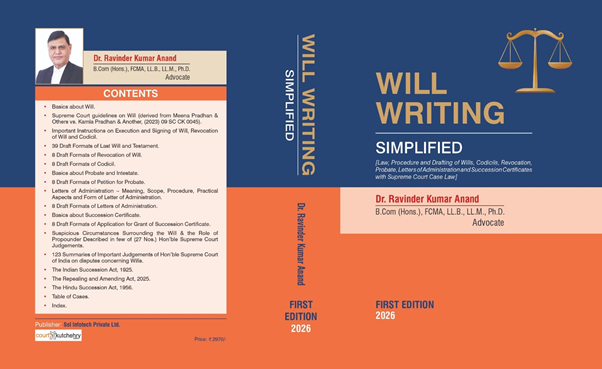
If you want practical guidance on drafting wills, codicils, and probate procedures, Will Writing Simplified [Law, Procedure and Drafting of Wills, Codicils, Revocation, Probate, Letters of Administration and Succession Certificates with Supreme Court Case Law] is an invaluable resource. It provides practical insights and case references, making it useful for lawyers, law students, and researchers.
You can access it here: Amazon | Flipkart
What Section 269SS Says
- Threshold limit: No person can accept loans, deposits, or specified sums of ₹20,000 or more in cash.
- Mode of transaction: Such transactions must be carried out through an account payee cheque, bank draft, or electronic clearing system (ECS).
- Penalty: Violations attract a penalty under Section 271D, equal to the amount of the loan or deposit.
- Relief provision: Section 273B provides relief if the person can prove a “reasonable cause” for non-compliance.
This means that lending or borrowing cash above ₹20,000—even between relatives—can technically attract penalties if not routed through banking channels.
Why This Law Exists
The primary purpose of Section 269SS is to:
- Prevent large unaccounted cash transactions.
- Reduce the risk of money laundering and tax evasion.
- Ensure transparency in financial dealings.
By mandating banking channels, the law creates a clear audit trail for loans and deposits.
Lending Cash to Relatives: Is It Illegal?
- Small amounts: Lending cash below ₹20,000 is not prohibited.
- Above ₹20,000: Lending cash above this limit—even to relatives—must be done via cheque, draft, or electronic transfer.
- Penalty risk: If you lend ₹50,000 in cash to a cousin, the borrower may face a penalty equal to ₹50,000 under Section 271D.
- Relief possibility: Courts have recognized that genuine family transactions may qualify for relief under Section 273B if reasonable cause is shown.
Key Court Rulings
- Asstt. Director of Inspection v. Kum. A.B. Shanthi (2002)
- Supreme Court upheld the constitutional validity of Section 269SS.
- Emphasized that the law applies even to genuine transactions, though relief may be granted under Section 273B.
- CIT v. Triumph International Finance (2009)
- Bombay High Court held that violation of Section 269SS attracts penalty, but relief may be granted if transactions are genuine and reasonable cause is shown.
- CIT v. Idhayam Publications Ltd. (2006)
- Madras High Court clarified that transactions between partners and firms may not always attract penalties if they are genuine.
These rulings show that while the law is strict, courts have provided relief in genuine family or business transactions.
Practical Examples
- Case 1: You lend ₹15,000 cash to your brother → Allowed, no violation.
- Case 2: You lend ₹25,000 cash to your cousin → Violation of Section 269SS, penalty possible.
- Case 3: You lend ₹50,000 cash to your mother for urgent medical expenses → Technically a violation, but relief may be available under Section 273B if reasonable cause is proven.
Penalties and Relief
- Penalty under Section 271D: Equal to the amount of cash loan or deposit.
- Relief under Section 273B: If you can prove reasonable cause (e.g., medical emergency, lack of banking facilities), penalty may be waived.
- Burden of proof: The taxpayer must demonstrate genuine circumstances.
Implications for Families
- Financial discipline: Encourages use of banking channels even for family loans.
- Transparency: Creates a record of transactions, reducing disputes.
- Risk awareness: Families must be aware of penalties before lending large sums in cash.
- Legal safeguards: Courts may provide relief, but prevention is better than cure.
Broader Legal Significance
Section 269SS is part of India’s broader effort to curb black money and promote digital transactions. It reflects the government’s push for transparency in financial dealings.
For ordinary citizens, the law means that even family loans must follow formal banking procedures. This may feel restrictive, but it ultimately protects both lender and borrower.
Conclusion
Lending cash to relatives is not illegal per se, but if the amount exceeds ₹20,000, it must be routed through banking channels. Violations can attract penalties equal to the loan amount under Section 271D. However, relief may be available under Section 273B if genuine reasons are shown.
The safest approach is to always use cheques, drafts, or electronic transfers for loans above ₹20,000—even within families. This ensures compliance with the law, protects against penalties, and creates a transparent record of transactions.
Suggested Keywords for Faster Searches
- Section 269SS Income Tax Act cash loan relatives
- Is lending cash to relatives illegal India
- Cash loan above ₹20,000 penalty Section 271D
- Section 273B relief for cash loan violation
- Supreme Court ruling Section 269SS Shanthi case
- Family loans cash transaction rules India
- Income Tax Act cash loan relatives law
- Penalty for cash loan above ₹20,000 India
Also Read: Supreme Court Clarifies Section 29A: Arbitrator Substitution Not Automatic After Mandate Ends