Supreme Court Clarifies: Doctrine of Merger Does Not Extinguish High Courts’ Contempt Powers
Top Court rules that High Courts retain authority to punish contempt even after their orders merge with Supreme Court rulings.
Judgment in United Labour Federation vs. Gagandeep Singh Bedi reinforces independence of High Courts.
By Legal Reporter
New Delhi: February 28, 2026:
In a landmark judgment, the Supreme Court of India has held that the doctrine of merger does not take away the power of High Courts to initiate contempt proceedings for disobedience of their own orders. The ruling came in the case of United Labour Federation vs. Gagandeep Singh Bedi, where the Madras High Court had earlier refused to entertain a contempt petition on the ground that its order had merged with a Supreme Court ruling. The apex court clarified that even after such merger, the High Court’s authority to enforce compliance with its directions remains intact.
Also Read: CJI Surya Kant Vows Registry Reforms After Shocking Plea Resurfacing
Background: What Is the Doctrine of Merger?
- Doctrine of Merger: A legal principle stating that when a higher court passes a judgment in appeal, the lower court’s order merges into the higher court’s ruling.
- Purpose: Ensures consistency and finality in judicial decisions.
- Controversy: Whether this doctrine extinguishes the lower court’s power to punish contempt of its original orders.
[Resource Note]
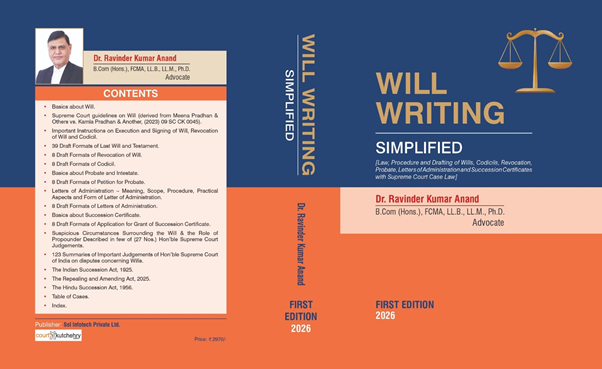
If you want practical guidance on drafting wills, codicils, and probate procedures, Will Writing Simplified is an invaluable resource. BUY HERE: Amazon 🔹 Flipkart
Also Read: Supreme Court Slams Tribunals as Liability, Calls Them Government’s Headache
Supreme Court’s Key Observations
- The Bench of Justices Prashant Kumar Mishra and NV Anjaria ruled that the doctrine of merger does not apply to contempt jurisdiction.
- High Courts retain the power to punish for contempt of their orders, even if those orders are later affirmed or modified by the Supreme Court.
- The Court emphasized that contempt jurisdiction is a constitutional power under Article 215, which cannot be diluted by procedural doctrines.
Case Details
- Madras High Court’s Position: It had refused to hear a contempt petition, reasoning that its earlier judgment had merged with the Supreme Court’s ruling.
- Supreme Court’s Intervention: Set aside the High Court’s refusal and restored the contempt petition for hearing.
- Implication: Litigants can approach High Courts for contempt even after the Supreme Court has dealt with the substantive matter.
Broader Legal Context
- In earlier rulings, the Supreme Court had clarified that the doctrine of merger is not rigid or universal. It cannot be applied mechanically to extinguish all powers of lower courts.
- Legal experts note that this judgment strengthens the independence of High Courts and ensures accountability for compliance with judicial orders.
Impact of the Judgment
For High Courts
- Reinforces their constitutional authority under Article 215.
- Ensures they remain effective guardians of justice at the state level.
Also Read: IRDAI Plans Sweeping Reforms to Cut Insurance Costs in India
For Litigants
- Provides clarity that contempt petitions can be filed in High Courts even after Supreme Court rulings.
- Strengthens remedies against non-compliance with judicial directions.
For Judicial System
- Balances hierarchy with autonomy.
- Prevents misuse of the doctrine of merger to escape accountability.
Expert Opinions
- Legal Scholars: Applaud the ruling as a safeguard against erosion of High Court powers.
- Practitioners: Stress that the judgment will prevent litigants from exploiting technicalities to avoid contempt proceedings.
- Critics: Warn that overlapping jurisdictions may lead to confusion but acknowledge that constitutional powers must prevail.
Conclusion
The Supreme Court’s ruling that the doctrine of merger does not extinguish High Courts’ contempt powers is a significant reaffirmation of judicial independence. By clarifying that High Courts retain authority to enforce compliance with their orders, even after merger with Supreme Court rulings, the judgment strengthens accountability and ensures that justice is not undermined by procedural technicalities.
Keywords for Faster Searches
Also Read: DGCA Introduces 48-Hour Free Cancellation Rule, Tightens Airline Refund Deadlines
- Doctrine of merger Supreme Court India
- High Court contempt powers Article 215
- United Labour Federation vs Gagandeep Singh Bedi
- Supreme Court contempt jurisdiction ruling
- Madras High Court contempt petition
- Doctrine of merger contempt case India
- Supreme Court judgment February 2026
- Contempt of court powers High Court India
Also Read: Supreme Court Seeks Response on Zoomcar’s Plea Over GST Appeal Denial