
Supreme Court Examines Dowry Complaint Against Married Man by Live-In Partner: A Landmark Case on Section 498A
Can Dowry Harassment Laws Apply Beyond Marriage? SC Seeks Government’s View
Case Raises Questions on Legal Rights of Women in Live-In Relationships
By Legal Reporter
New Delhi: February 14, 2026:
In a case that could redefine the scope of India’s dowry harassment laws, the Supreme Court is examining whether a married man can be prosecuted under Section 498A of the Indian Penal Code (IPC) based on a complaint filed by his live-in partner. The matter has sparked intense debate in legal circles, as the law traditionally applies only to a “husband” and his “wife.” The outcome of this case may set a precedent for how live-in relationships are treated under criminal law in India.
Also Read: Supreme Court: High Courts Must Address All Issues in Writ Petitions, Not Just One Point
[Recommended Legal Resource]
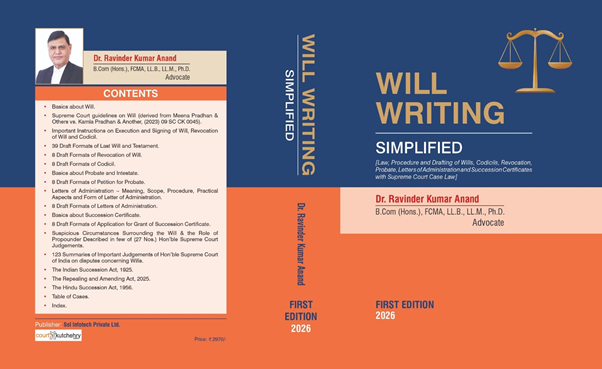
For readers interested in understanding the complexities of Indian family law, wills, succession, and Supreme Court precedents, the book Will Writing Simplified [Law, Procedure and Drafting of Wills, Codicils, Revocation, Probate, Letters of Administration and Succession Certificates with Supreme Court Case Law] is highly recommended. It provides practical guidance on legal drafting and case law interpretation.
Background of the Case
The case involves Dr. Lokesh B H, a cardiologist from Karnataka, who has challenged a Karnataka High Court order refusing to quash criminal proceedings against him. His live-in partner, Teertha, accused him of dowry harassment and even attempted murder.
- Lokesh has been legally married to Naveena since 2000.
- Teertha claims she married Lokesh in 2010 and later filed multiple complaints against him and his family members.
- In 2016, she alleged that Lokesh tried to burn her while demanding dowry. However, his employer certified that he was at work during the alleged incident.
- Despite earlier complaints being closed, police filed a chargesheet in 2023, leading Lokesh to approach the High Court, which dismissed his plea.
Now, the Supreme Court has stepped in to decide whether Section 498A can extend to live-in relationships.
What Section 498A Says
Section 498A IPC states:
“Whoever, being the husband or the relative of the husband of a woman, subjects such woman to cruelty shall be punished with imprisonment for a term which may extend to three years and shall also be liable to fine.”
- Cruelty under this section includes dowry demands, harassment, and ill-treatment.
- The law was designed to protect married women from domestic violence and dowry harassment.
- The central question now is whether a live-in partner can be treated as a “wife” under this provision.
Supreme Court’s Stand
A bench of Justices Sanjay Karol and N Kotiswar Singh has sought responses from the Union Government and the Karnataka Government. The court has also appointed Advocate Nina Nariman as amicus curiae to assist in the matter.
The judges emphasized that the case is not just about one individual but about clarifying the law for thousands of women in live-in relationships across India.
Also Read: Is Lending Cash to Relatives Illegal? Understanding Section 269SS of the Income Tax Act
Why This Case Matters
This case is significant because:
- Legal Ambiguity: Current laws do not clearly define the rights of women in live-in relationships.
- Social Impact: With live-in relationships becoming more common, the judgment could affect many couples.
- Women’s Protection: Extending Section 498A to live-in partners could provide stronger protection against abuse.
- Potential Misuse: Critics argue that expanding the law may lead to misuse, like concerns already raised about dowry laws.
Expert Opinions
Legal experts are divided:
- Supporters of Expansion: They argue that women in live-in relationships deserve equal protection, especially when the relationship resembles marriage.
- Opponents: They caution that the law was drafted specifically for marital ties and expanding it could blur legal definitions and complicate family law.
Broader Legal Context
India has gradually recognized live-in relationships in various judgments:
- The Supreme Court has previously held that long-term live-in relationships can be considered “relationships in the nature of marriage.”
- Under the Protection of Women from Domestic Violence Act (2005), women in live-in relationships are entitled to protection from abuse.
- However, criminal provisions like Section 498A have not yet been explicitly extended to live-in partners.
Possible Outcomes
The Supreme Court’s decision could lead to:
Also Read: Supreme Court Allows Patent Mapping in Cancer Drug Dispute Between Bristol Myers Squibb and Zydus
- Expansion of Section 498A to include live-in partners.
- Clarification of Legal Definitions of “wife” and “husband” in criminal law.
- Guidelines for Courts to handle similar cases in the future.
Conclusion
The Supreme Court’s examination of this case could mark a turning point in Indian jurisprudence. Whether Section 498A will be extended to live-in relationships remains to be seen, but the debate highlights the evolving nature of family law in India. As society changes, the law must adapt to ensure justice and protection for all women, regardless of marital status.
Suggested Keywords for SEO & Faster Searches
- Supreme Court dowry case 2026
- Section 498A live-in relationship India
- Dowry harassment law Supreme Court
- Married man live-in partner dowry complaint
- Karnataka High Court dowry case
- Indian Penal Code Section 498A
- Live-in relationship legal rights India
- Supreme Court dowry judgment pending
- Domestic violence law live-in partners
- Will Writing Simplified book legal resource
Also Read: McDonald’s India Outlet Warned Over Rotten Tomatoes and Reused Oil: Food Safety Laws in Focus